Why Your Product Pages Aren't Showing Up in AI Answers
Product pages often fail to appear in AI shopping answers because their data is not structured, intent-rich, or current enough for LLMs to confidently recommend them, and the fix is to make product pages machine-readable, answer-ready, and continuously measured through tools like Anagram.

TL;DR
Your product pages don't appear in AI answers because large language models read structured product data, not marketing copy — and most catalogs either lack that data or describe products in ways AI can't match to shopper intent. The fix is making each product machine-readable, intent-tagged, and answer-ready, then tracking where you actually surface. Platforms like Anagram exist to do both halves of that work.
Why don't my products show up in ChatGPT and other AI answers?
Your products don't show up because AI shopping assistants build recommendations from structured product data, and most e-commerce catalogs don't supply enough of it. When a shopper asks an AI what to buy, the model parses machine-readable attributes — not the persuasive copy a human reads on the page.
This is a different retrieval path than search. A traditional crawler infers meaning from page copy and link signals; an LLM-based assistant prefers explicitly defined metadata and discounts what it has to guess at. When you interact with a shopping assistant powered by an LLM, you're not triggering a traditional search engine — the model interprets the underlying shopping intent and surfaces recommendations by parsing structured product feeds from connected merchants. Marpipe
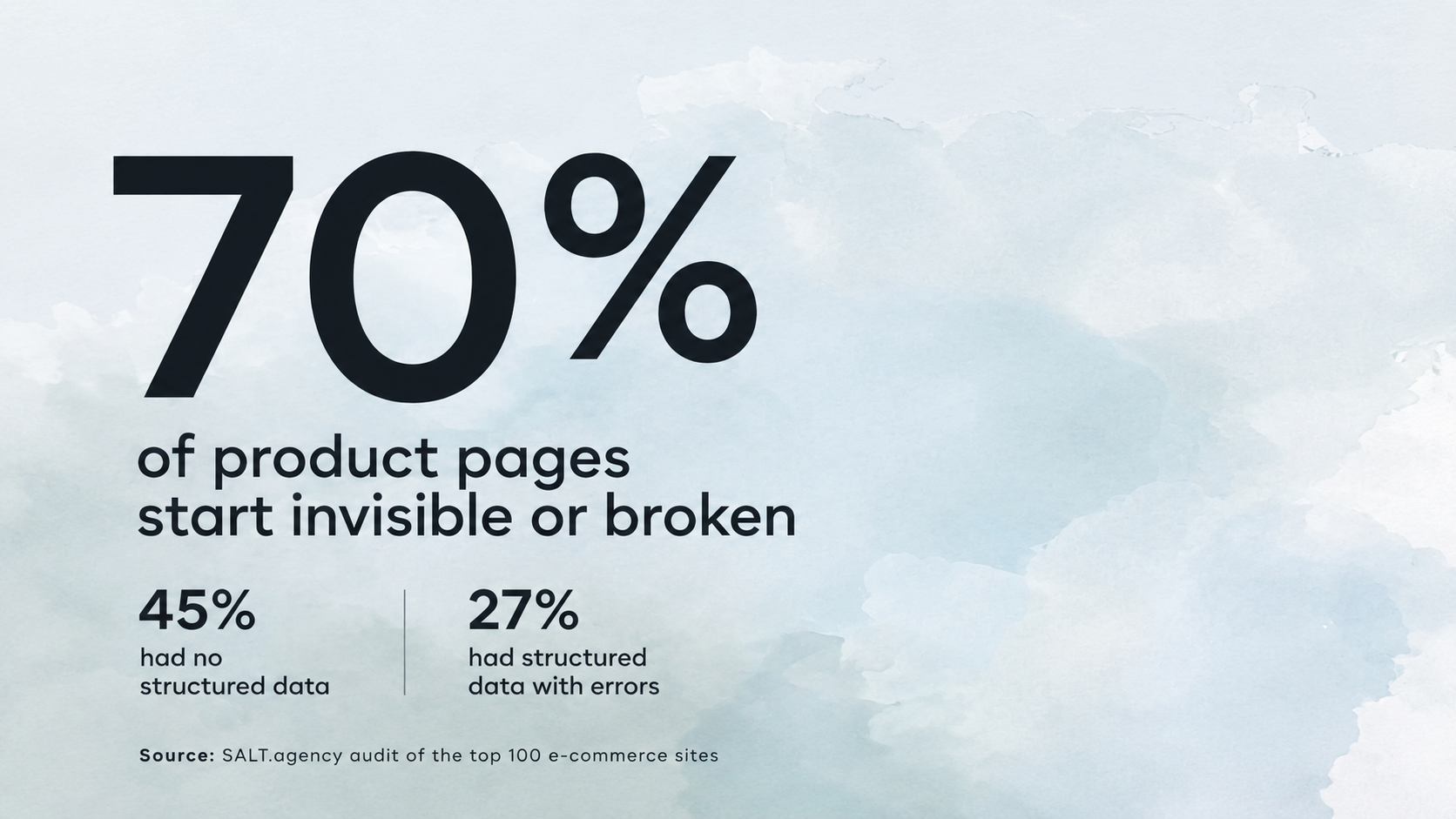
The scale of the gap is measurable. A SALT.agency audit of the top 100 e-commerce sites found that 45% of product URLs contained no structured data at all, and another 27% contained structured data with errors. So before any clever optimization, roughly seven in ten product pages are starting invisible or broken. The first step toward fixing that is seeing it — which is what an AI visibility report from a tool like Anagram is built to surface. Ziptie
How do AI shopping assistants actually read product pages?
AI assistants ingest products through four channels — web crawls, search indexes, product feeds, and retrieval systems — and assemble a working model of what your store sells and who it's for. They favor explicit, structured information over inferred meaning at every step.
The mechanics break down into a few distinct routes.
AI crawlers and structured markup
Purpose-built bots like OpenAI's OAI-SearchBot scan pages much as Googlebot does. These bots retrieve HTML content, headings, lists, tables, and structured data marked up with schema.org. Clean JSON-LD on each product page is the most reliable way to hand them unambiguous facts. Semly
Product feeds and the Knowledge Graph
For Google's AI surfaces, schema doesn't talk to the model directly. Product schema feeds Google's Knowledge Graph through the crawl and indexing pipeline, and AI Overviews draw from that Knowledge Graph when generating product recommendations. The essential properties are name, image, description, offers (price, currency, availability), brand, sku, gtin, and aggregateRating. ZiptieZiptie
Retrieval-augmented generation
On-site and assistant environments often build a local index of your store. RAG-based shopping assistants index your categories, product cards, FAQs, and blog content, then retrieve snippets from it to answer questions and infer what you specialize in. If your pages don't contain the answer to a shopper's question in plain text, the assistant has nothing to pull. This is exactly why the conversational experiences Anagram puts on a product page matter for discovery as well as conversion — they create answer-rich content where there was none. Semly
What makes a product page invisible to AI?
A product page goes invisible when its data is missing, error-ridden, or redundant — when it gives the model nothing it can't already infer. The most common failure isn't too little content; it's content that restates the spec table instead of explaining real-world fit. Ocula
Five recurring causes account for most invisibility:
No structured data. With no schema, the model is left to guess from prose, and it would rather recommend a competitor it's certain about.
Broken or invalid schema. A page can pass validation and still fail to surface; errors and gaps quietly remove you from consideration.
Redundant enrichment. The most common mistake in product enrichment for AI agents is restating information already present in the spec table — an LLM can read spec tables already and doesn't need a second, less-structured copy. Ocula
No intent hooks. Use-case tags act as intent-matching hooks: when a shopper asks for "something for hosting dinner parties," the agent needs to match that intent to specific products. Without them, you don't match conversational queries. Ocula
Stale data. Outdated pricing, availability, or specs erode the trust signals AI weighs when deciding what to recommend.
The throughline: the products that win in LLM-driven discovery aren't the ones with the most data, but the ones with the most useful data — structured for how agents reason, grounded in real-world evidence, and honest about strengths and weaknesses. Knowing which of these five is hurting you is a diagnosis problem first — Anagram's reporting is designed to point at the specific gap rather than leave you guessing. Ocula
Why does this matter now?
It matters because discovery is shifting to a channel where appearing in the answer, not ranking on a page, is what wins the customer — and a large share of those answers never send a click. If you're absent from the AI's recommendation, you're often eliminated before a shopper ever sees your site.
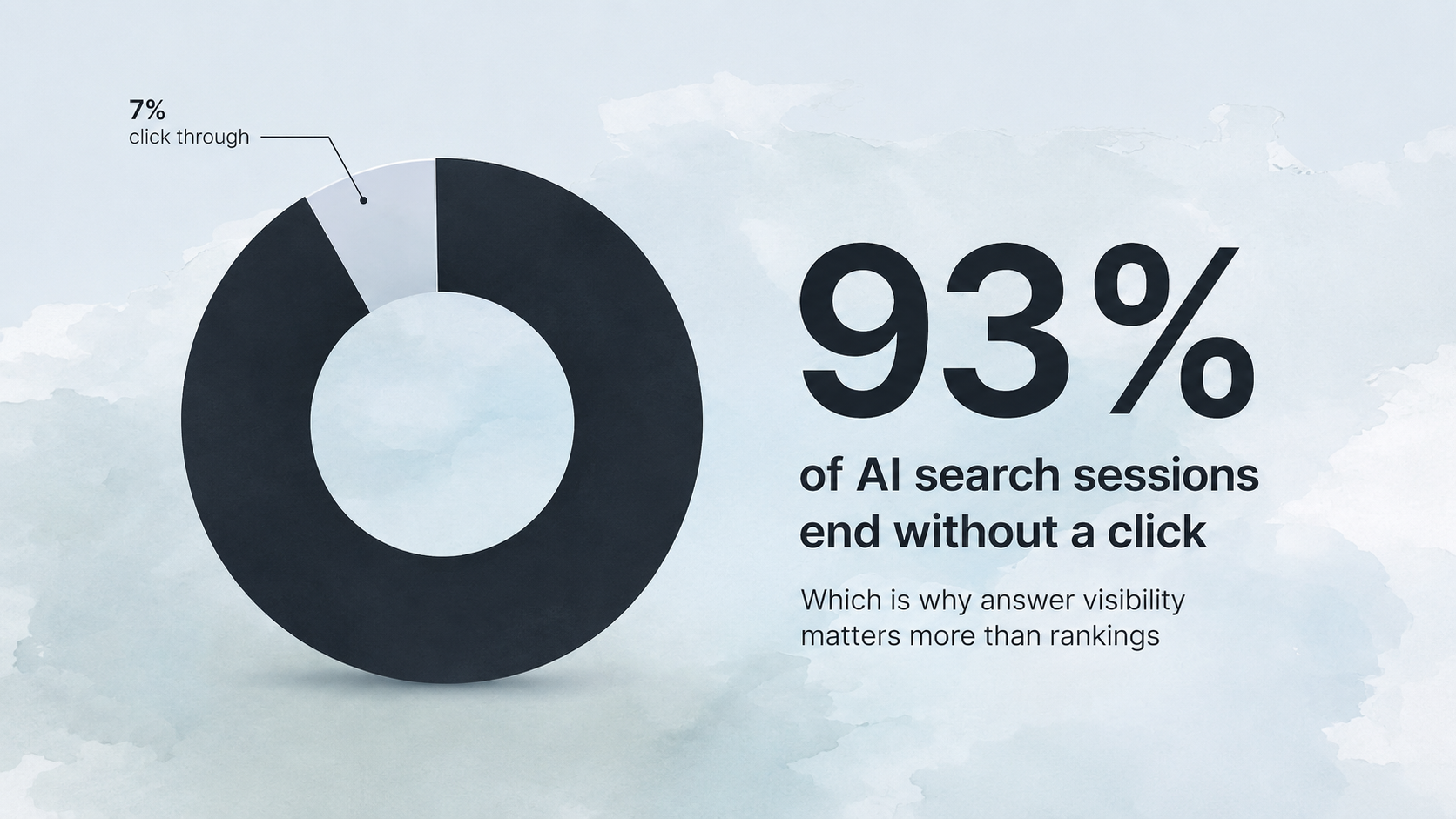
The behavioral shift is well documented. Gartner forecasts that traditional search engine volume will drop 25% by 2026 as search marketing loses share to AI chatbots and other virtual agents. Roughly 93% of AI search sessions end without a website click, which makes answer visibility more important than traditional rankings. GartnerSuperlines
The stakes are highest for unbranded, research-style queries — exactly the "what should I buy" moments AI is absorbing. Forrester frames this as agentic commerce: AI assistants can now read product data, compare options, and even complete purchases without human clicks, meaning a product page that isn't structured and detailed may never be considered — a lost sale before a buyer ever visits the site. Perrill
There is an upside worth naming. The minority of AI interactions that do drive a visit tend to be high-intent, and brands cited in AI answers see measurably better engagement than those relying on traditional links alone. Visibility in the answer compounds into brand recognition even when the click doesn't come.
How do I fix product pages so AI recommends them?
Fix product pages by making each one machine-readable, intent-tagged, evidence-backed, and current — then measure where you surface so you can close the gaps that remain. Treat product data as a strategic asset, not page decoration. The steps below are the work; Anagram is built to compress most of it from a multi-week engineering project into something a brand team can run on its own. Marpipe
1. Implement and validate product schema on every page
Add JSON-LD with the AI-critical properties — name, description, offers, brand, gtin, aggregateRating — to each product page, then validate it. In e-commerce, structured data helps models parse price, stock status, and reviews, which increases the chances of inclusion in AI-powered recommendations, and JSON-LD placed in a script block is the format crawlers parse most reliably, including those that don't execute JavaScript. InsightlandInsightland
2. Enrich with information AI can't already extract
Don't restate the spec sheet. Add the context an agent needs to answer a shopper confidently: who the product is for, what use cases it fits, where it falls short, and how it compares. This is the data that lets an agent answer with confidence rather than hallucinating. The fastest way to find that missing context is to watch what shoppers actually ask — Anagram captures those questions and turns them into a map of what each product page is missing. Ocula
3. Add use-case and intent tags
Tag products against the real questions shoppers ask in natural language, so conversational queries map to specific SKUs rather than dead-ending. Because Anagram sees the real phrasing customers use, the intent tags it surfaces reflect how people actually shop rather than how a catalog team assumes they do.
4. Keep pricing, availability, and specs current
AI shopping optimization emphasizes product data quality, consistency across channels, and data freshness — keeping prices, availability, and specifications current — alongside natural-language descriptions optimized for semantic understanding rather than keyword density. OpenAI
5. Answer questions on the page itself
Shoppers arriving from AI come with sharper, more specific questions. Surfacing clear answers — in product copy, FAQs, and on-site conversational experiences — both helps the customer convert and feeds the retrieval systems that decide whether to recommend you next time. This is the core of what Anagram launches on a page: a branded experience that answers in the moment, the same way Dakine's product finder, Divi's expert, and Bote's support do.
6. Measure where you actually appear
You can't fix what you can't see. Citation gap analysis — comparing where your brand should appear in AI answers versus where it currently does — is the most direct way to find the openings, the AI equivalent of a keyword gap analysis but comparing who gets quoted rather than who ranks. Anagram runs this continuously, tracking share of voice, mention rank, and where competitors are winning, so a fix can be confirmed rather than assumed. Asky
How does Anagram help with this?
Anagram closes the loop between the two halves of the problem: it puts answer-rich, conversational experiences on your product pages, and it reports on how AI platforms understand and recommend your brand. Most teams treat on-site experience and AI visibility as separate tools; Anagram connects them so each customer interaction improves the next.
The practical sequence looks like this.
Engage. Launch branded conversational experiences — product finders, expert answers, location finders — in minutes rather than waiting on a developer and a design sprint. These give shoppers the help they expect when comparing options, and they generate the plain-language, intent-rich content that retrieval-based AI can actually pull from.
Learn. Every interaction reveals what customers are asking, what they care about, and where they hesitate before buying. That signal is the raw material for the enrichment and intent-tagging work in steps 2 and 3 above — you're no longer guessing what context your product data is missing.
Improve. Feed what you learn back into your pages and content, then watch how it changes the way AI describes and recommends you. Anagram's visibility report shows where you show up across AI platforms, where competitors lead, and where your biggest openings are — the measurement layer that confirms the rest of the work landed.
Brands including Dakine, Divi, and Bote use this loop to answer questions at the moment of decision instead of losing shoppers to hesitation — the same moments that increasingly happen inside an AI assistant before a shopper ever reaches the site.
How AI product visibility compares to related concepts
Concept | What it is | How it relates to AI product visibility |
|---|---|---|
Traditional SEO | Optimizing pages to rank in blue-link search results | Still feeds Google's index, but ranking ≠ being recommended by AI |
GEO / AEO | Optimizing content to be cited by AI answer engines | The broader discipline; AI product visibility is its e-commerce application |
Structured data / schema | Machine-readable markup describing page content | The primary input AI uses to understand and recommend products |
Product feed optimization | Structuring catalog data for shopping channels | The catalog-level version of the same machine-readability goal |
Frequently asked questions
Is schema markup enough to get my products into AI answers?
No. Schema is necessary but not sufficient. It makes your products machine-readable and feeds Google's Knowledge Graph, but products still need intent context, freshness, and evidence to be chosen over alternatives. Valid schema that passes validation can still fail to surface.
Why do my competitors show up in ChatGPT when I don't?
Usually because their product data is more complete, more current, or better matched to how shoppers phrase questions — not because they spend more. AI favors the source it's most certain about. A citation gap analysis — the kind Anagram runs — will show you exactly which queries they win and you don't.
Does AI shopping traffic actually convert?
The volume is smaller than traditional search, but the intent is higher — the shoppers who click through after an AI recommendation have already narrowed their choice. Appearing in the answer also builds brand recognition that pays off in later, direct visits.
How long does it take to see results after fixing product data?
It varies by how AI surfaces re-crawl and re-index your catalog. Schema and feed changes propagate over weeks rather than days, which is why ongoing measurement matters more than a single before/after check.
Sources
Gartner — Gartner Predicts Search Engine Volume Will Drop 25% by 2026 (2024)
Superlines — AI Search Statistics 2026 (March 2026)
SALT.agency / ZipTie.dev — Product Schema for AI Commerce (April 2026)
Marpipe — How to Structure Your Product Feed for AI Shopping (January 2026)
Ocula — Your Product Data Isn't Ready for AI Shopping Agents (2026)
Perrill — Prepping Your E-Commerce Site for LLM Checkout, citing Forrester (February 2026)
ALM Corp — ChatGPT Shopping Research: LLM Optimization for E-Commerce (December 2025)
Insightland — The Role of Structured Data in AI Search Visibility (November 2025)
Semly — How to Write Content So That LLMs Will Recommend Your Store (February 2026)
Asky Labs — Identify Opportunities to Improve AI Search Visibility (2026)