Why Does ChatGPT Recommend Some Brands and Not Others in 2026?
A practical explanation of why ChatGPT recommends some brands over others, including crawl access, relevance, evidence, freshness, fit, off-site reputation, product data, and how to track recommendation gaps.
TL;DR
ChatGPT tends to recommend brands when it can find reliable, relevant, recent, and specific evidence that matches the user's prompt. Visibility usually comes from crawlable pages, clear product and comparison content, third-party mentions, reviews, structured catalog data, and source authority. You cannot force a recommendation, but you can make your brand easier to retrieve, verify, and cite.
Why does ChatGPT recommend some brands and not others?
ChatGPT recommends some brands because they are easier to find, understand, verify, and match to the user's exact need. When ChatGPT searches the web, OpenAI says ranking is based on factors meant to surface reliable and relevant information; when it does not search, the answer depends more on the model's learned associations and available context.
For a brand, that creates two different visibility problems:
Recommendation path | What matters most | Brand risk |
|---|---|---|
ChatGPT searches the web | Crawlability, relevance, source quality, freshness, page clarity | Your site or mentions may be missing from the retrieved source set |
ChatGPT answers from model knowledge/context | Brand awareness, repeated associations, prior public mentions, user context | Better-known competitors may be the default answer |
ChatGPT shopping/product experiences | Product feeds, catalog completeness, price, availability, reviews, seller data | Your product data may be too thin or stale to surface accurately |
OpenAI's ChatGPT Search help page says responses can include citations and source panels, and it specifically says site inclusion depends in part on allowing OAI-SearchBot and traffic from OpenAI's published IP ranges. That does not guarantee placement, but it makes crawl access the first filter.
How does ChatGPT decide which brands to suggest?
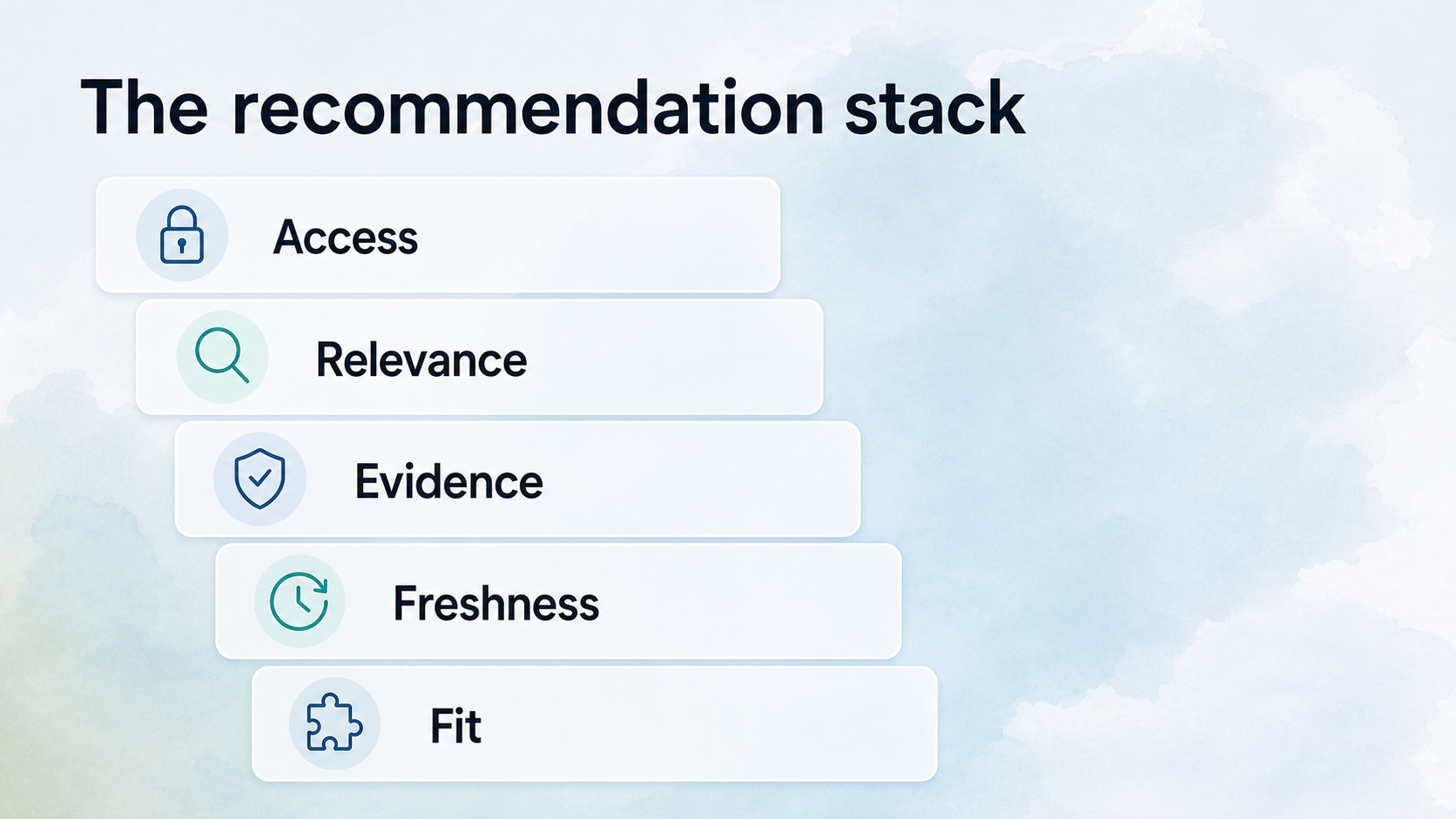
ChatGPT does not publish a single public brand-ranking formula. The practical model is a stack of filters: can it access your content, does your content answer the prompt, do credible sources support the claim, is the information current, and does the brand fit the user's constraints such as budget, category, location, size, or use case?
Think of the recommendation process as five layers:
Layer | What ChatGPT is trying to resolve | What a brand can improve |
|---|---|---|
Access | Can the system reach the page or product data? | Robots.txt, OAI-SearchBot access, CDN rules, fast server responses |
Relevance | Does the content match the user's question? | Buyer-question pages, comparison pages, clear H2s, product-use language |
Evidence | Can the claim be verified? | Sources, reviews, case studies, third-party mentions, structured data |
Freshness | Is the information current enough? | Updated pages, current pricing, product availability, recent examples |
Fit | Does the brand satisfy the user's constraints? | Clear segments, pricing, integrations, industries, pros/cons |
The biggest mistake is treating "show up in ChatGPT" as one generic ranking. A shopper asking "best trail running shoes for wide feet under $150" is not asking the same thing as "best premium hiking boot brand." The brands that surface are the ones with evidence for that precise job.
Why does ChatGPT recommend my competitor and not me?
ChatGPT may recommend a competitor because the competitor has clearer public evidence for the prompt. That evidence may be a comparison page, product reviews, Reddit discussions, publisher mentions, marketplace data, or a page that directly says who the product is best for. Better content often beats better products when the assistant lacks usable proof.
Common reasons a competitor wins the answer:
Their product pages describe use cases in language buyers actually ask.
Their site is crawlable by OAI-SearchBot while yours is blocked or hard to parse.
They are mentioned in third-party lists, reviews, forums, and category pages.
Their pricing, availability, integrations, and shipping details are easier to verify.
Their pages include direct answers, not only brand storytelling.
Their category pages are updated more recently.
This is why manual spot checks are misleading. One prompt might show your brand, while ten adjacent prompts reveal that ChatGPT consistently chooses a competitor for certain use cases, budgets, or audience types. Anagram's AI Visibility workflow is built for that pattern: track the prompts, see which competitors are winning, inspect the cited sources, and turn the gaps into content fixes.
Is my website content or off-site reputation more important for ChatGPT recommendations?
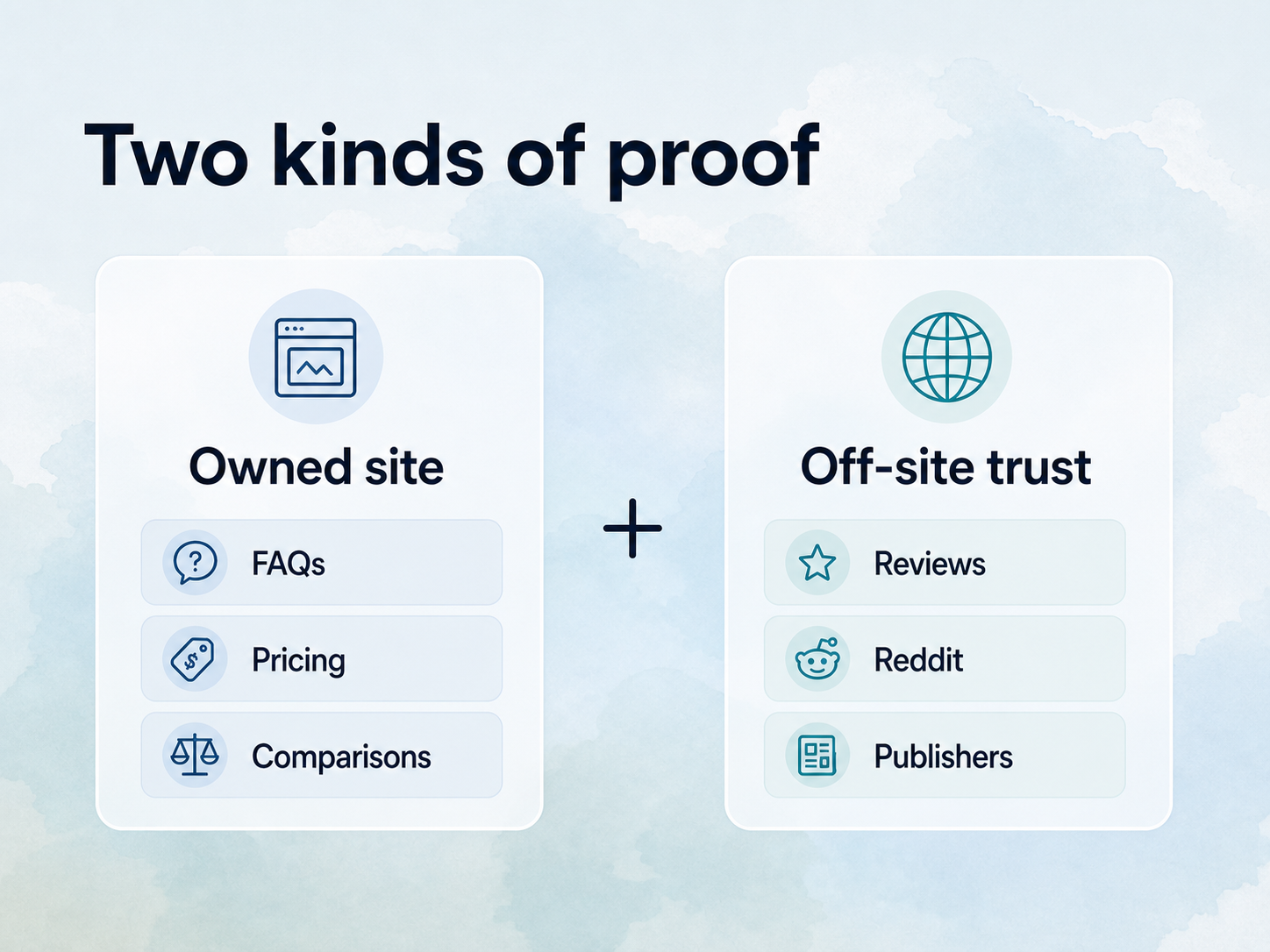
Both matter, but they do different jobs. Your website gives ChatGPT controlled facts about your products, pricing, use cases, and positioning. Off-site reputation gives the assistant independent evidence that your claims are credible. The strongest brands usually have both: clear owned content and repeated third-party validation.
Owned content is especially important for factual precision. If your product supports Shopify, has a free trial, ships to Canada, or fits a certain budget, your site should say that in plain text where crawlers can reach it.
Off-site reputation is especially important for trust. ChatGPT Search was designed to connect users with original web sources, and OpenAI's shopping updates have emphasized reviews, product details, and external purchase paths. In practice, a brand mentioned by reviewers, publishers, community threads, and comparison pages gives AI systems more corroborating material than a brand that only praises itself.
Signal type | Helps ChatGPT answer | Example content |
|---|---|---|
Owned site content | "What does this brand actually offer?" | Product pages, FAQs, pricing, comparison pages, docs |
Third-party mentions | "Does anyone else validate this brand?" | Reviews, media lists, Reddit threads, partner pages |
Structured product data | "Can I show accurate product details?" | Product feeds, price, images, availability, variants |
User context | "Which option fits this person?" | Budget, location, memory, prompt constraints |
How do I make my brand easier for ChatGPT to recommend?
Make your brand easy to retrieve, easy to verify, and easy to match to buyer intent. Start with crawl access, then build pages that answer specific recommendation prompts, then strengthen third-party proof. Do not optimize one homepage and expect it to carry every answer.
Use this checklist:
Allow OAI-SearchBot if you want ChatGPT Search visibility.
Keep important answers in server-rendered or easily parsable HTML.
Add direct Q&A sections for the prompts buyers actually ask.
Create comparison pages that honestly state where you fit and where you do not.
Keep pricing, integrations, availability, shipping, and support details current.
Add proof: reviews, case studies, customer examples, and cited sources.
Earn off-site mentions in places buyers and AI systems already consult.
Track prompts over time instead of relying on one-off screenshots.
For DTC brands, the fastest page to improve is often not the homepage. It is the page that answers a buying constraint: "best gift for a runner under $100," "waterproof backpack for commuting," "AI visibility tool for Shopify," or "skin care brand for sensitive skin."
What content helps ChatGPT understand when to recommend a brand?
The best content names the buyer, the use case, the constraint, and the proof in the same section. ChatGPT is better at recommending a brand when the page says who the product is for, what problem it solves, how it compares, and what evidence supports the claim.
High-leverage content formats include:
Content format | Why it helps recommendations | Example H2 |
|---|---|---|
"Best for" pages | Maps brand to a use case | "What is the best AI visibility tool for Shopify brands?" |
Comparison pages | Clarifies alternatives | "Anagram vs Athena HQ: which fits a DTC brand?" |
Product FAQs | Answers long-tail buyer questions | "Does this work for stores with large catalogs?" |
Evidence pages | Gives the assistant proof | "What changed after adding an AI site agent?" |
Category explainers | Defines the buying criteria | "What should a ChatGPT visibility tool track?" |
The wording matters. A section titled "Platform overview" is less retrievable than "What is the best AI visibility tool for a Shopify brand?" A paragraph that says "we help teams grow" is less useful than a sentence that says "Anagram tracks where a brand appears in ChatGPT, which competitors are mentioned, and which sources ChatGPT cites."
Do product feeds affect ChatGPT recommendations?
For shopping and commerce experiences, product feeds can matter because they give ChatGPT structured catalog data. OpenAI's commerce documentation says product feeds help ChatGPT index products, understand attributes, and present accurate product information such as titles, descriptions, images, price, and availability.
That does not mean every brand can simply upload a feed and win recommendations. OpenAI says feed onboarding is currently available to approved partners. But the direction is clear: AI shopping systems need clean, current, structured product facts.
Even if a brand is not yet submitting a product feed, the same discipline helps on the open web:
Product titles should be specific, not clever.
Descriptions should explain use cases and constraints.
Variant pages should keep size, color, price, image, and availability aligned.
Reviews and return policies should be accessible.
Product URLs should be stable and canonical.
Why is ChatGPT visibility hard to measure manually?
Manual checking is hard because ChatGPT answers can vary by prompt wording, location, time, search behavior, memory, and source availability. One answer is a snapshot, not a visibility score. The useful measurement is repeated tracking across a stable prompt set, competitor set, and citation history.
A practical report should capture:
Field | Why it matters |
|---|---|
Prompt | The exact buyer question tested |
Mention | Whether your brand appeared |
Position | Whether it appeared first, middle, or buried |
Competitors | Which brands were recommended instead |
Sources | Which pages or domains were cited |
Answer framing | Whether the description was accurate, favorable, or outdated |
Next action | What page, proof, or crawl issue to fix |
This is where Anagram fits naturally. The goal is not only to know whether ChatGPT mentioned you today. The goal is to understand which prompts you lose, why you lose them, and what content or proof would make the next answer more likely to include you.
What should I fix first if ChatGPT ignores my brand?
Fix the most obvious retrieval gap first. If ChatGPT cannot access your site, solve crawlability. If it can access the site but cites competitors, improve the page that should answer that prompt. If your content is clear but unsupported, build third-party proof and customer evidence.
Use this order:
Symptom | First fix |
|---|---|
ChatGPT never cites your site | Check OAI-SearchBot access, robots.txt, CDN blocking, sitemap coverage |
ChatGPT mentions competitors only | Create or update a buyer-question page for that exact prompt |
ChatGPT describes you incorrectly | Add a plain-language positioning block and update stale third-party profiles |
ChatGPT names you but does not recommend you | Add proof, comparisons, reviews, and clearer "best for" criteria |
ChatGPT recommends you for the wrong buyer | Clarify segments, exclusions, pricing, integrations, and use cases |
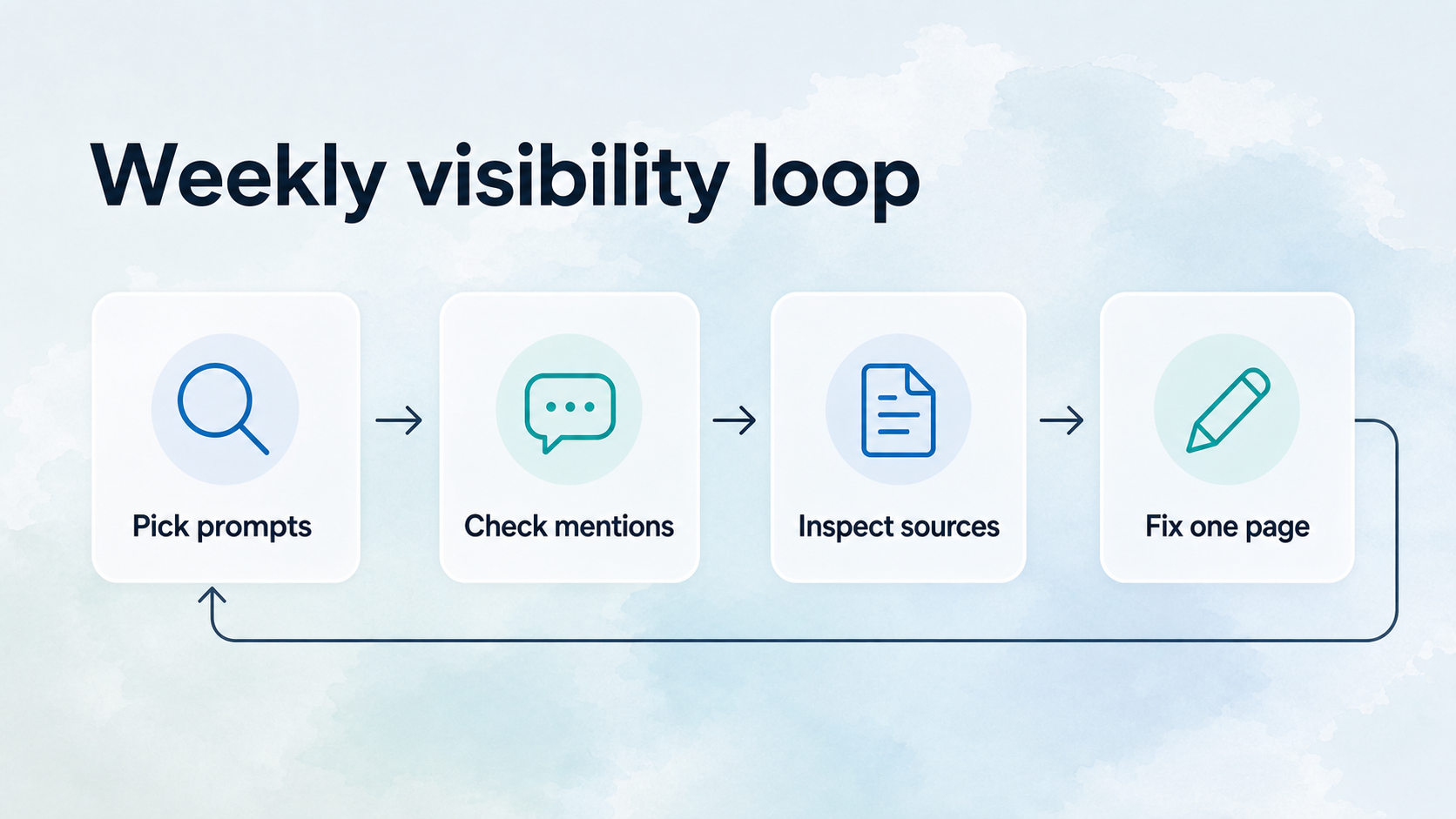
The highest-leverage workflow is weekly: pick 10 prompts, run a baseline, inspect sources, fix one page, improve one proof gap, and recheck. Visibility improves through repeated evidence, not one magic tag.
Frequently asked questions
Can I pay ChatGPT to recommend my brand?
No standard organic ChatGPT Search placement is not a simple pay-to-rank system. OpenAI says ChatGPT Search rankings are based on factors designed to help users find reliable, relevant information. OpenAI has also built separate commerce and ads products, but organic recommendations still need relevance, access, and evidence.
Does ChatGPT only recommend big brands?
No, but big brands often have more public evidence. They usually have more reviews, articles, category mentions, community discussions, and structured catalog data. Smaller brands can compete on specific prompts by being clearer, more current, and more directly relevant to niche use cases.
Does blocking GPTBot block ChatGPT recommendations?
GPTBot and OAI-SearchBot serve different purposes. OpenAI's crawler documentation separates user agents, and its ChatGPT Search help page specifically calls out OAI-SearchBot for inclusion in ChatGPT Search. Brands should decide separately how they treat training crawlers and search/retrieval crawlers.
How long does it take to change what ChatGPT recommends?
It depends on crawl timing, source changes, and the prompt. Some changes may show up after pages are crawled or search sources refresh; others require more third-party evidence over time. Track the same prompts weekly so you can see whether mentions, sources, and answer framing are moving.
What is the best first step for a DTC brand?
Start with 10 buyer prompts that include category, budget, use case, and comparison intent. Check whether your brand appears, which competitors are named, and what sources are cited. Then update the one page that should have answered the highest-intent prompt.
Sources
OpenAI Help Center, "ChatGPT Search": https://help.openai.com/en/articles/9237897-chatgpt-search
OpenAI, "Introducing ChatGPT search": https://openai.com/index/introducing-chatgpt-search/
OpenAI Developers, "Overview of OpenAI crawlers": https://platform.openai.com/docs/bots
OpenAI Developers, "Agentic Commerce: Get Started": https://developers.openai.com/commerce/guides/get-started
OpenAI Developers, "Agentic Commerce: Best practices": https://developers.openai.com/commerce/guides/best-practices
The Verge, "ChatGPT is getting better for shopping": https://www.theverge.com/news/656729/openai-chatgpt-search-shopping
Gartner, "Gartner Predicts Search Engine Volume Will Drop 25% by 2026": https://www.gartner.com/en/newsroom/press-releases/2024-02-19-gartner-predicts-search-engine-volume-will-drop-25-percent-by-2026-due-to-ai-chatbots-and-other-virtual-agents
Steinacker-Olsztyn, Gosain, and Dao, "Is Misinformation More Open? A Study of robots.txt Gatekeeping on the Web": https://arxiv.org/abs/2510.10315