What DTC Shoppers Actually Ask ChatGPT Before They Buy in 2026
DTC shoppers ask ChatGPT product-fit, comparison, trust, value, and risk questions before buying. This guide shows how brands can turn those questions into crawlable, ChatGPT-ready content and on-site AI experiences.

By Zach Luker - GEO Researcher at Anagram Published June 25, 2026 · Last updated June 25, 2026
TL;DR
DTC shoppers ask ChatGPT the same questions they bring to product pages: which product fits them, whether it is worth the price, how it compares with alternatives, what real buyers say, and what could go wrong. Brands win by answering those questions in crawlable content and on-site AI experiences.
What do people ask ChatGPT before buying?
People ask ChatGPT pre-purchase questions that reduce risk: “which one should I buy,” “is this worth it,” “how does it compare,” “will it work for my situation,” and “what are the downsides?” These questions sit between search, product pages, reviews, support, and buying guides.
The important shift is that shoppers are not only searching for a product category. They are asking an assistant to compress the decision for them.
OpenAI describes ChatGPT search as a way to get timely answers with links to relevant web sources. That means DTC brands are no longer optimizing only for a search result. They are trying to become one of the sources an AI system can use when it answers a purchase question.
For a DTC brand, the practical question is not “what keywords should we rank for?” It is “what buying questions should our site answer so clearly that ChatGPT can reuse them?”
What product-fit questions do DTC shoppers ask AI?
Product-fit questions are about matching a shopper’s constraints to the right product. A shopper might ask ChatGPT which running shoe works for wide feet, which scalp serum is safe for a sensitive scalp, or which paddle board is stable enough for a beginner.
These questions usually include a product category plus a use case, body type, skill level, problem, budget, or environment.
Examples:
Question pattern | Example shopper prompt | What the brand should answer |
|---|---|---|
Fit for me | “Which of these jackets works for a short torso?” | Sizing, fit notes, measurements, model context |
Fit for use case | “What paddle board is best for a beginner on lakes?” | Skill level, water type, stability, weight capacity |
Fit for problem | “What skincare product helps dryness without fragrance?” | Ingredients, sensitivities, contraindications |
Fit for setup | “Will this fit my current bike rack?” | Dimensions, compatibility, install constraints |
Fit for recipient | “What gift would work for a beginner snowboarder?” | Buyer persona, skill level, safe defaults |
Most product pages answer some of this, but not always in extractable language. If sizing advice is buried in an image, a tab, a quiz result, or a customer support thread, it is harder for AI systems to reuse.
What comparison questions do shoppers ask before choosing a brand?
Comparison questions ask ChatGPT to choose between products, brands, materials, price tiers, or buying paths. The shopper is often close to purchase but wants an outside synthesis before committing. These questions are high intent because they turn uncertainty into a short list.
Common comparison prompts include:
“Brand A vs Brand B: which is better for beginners?”
“Is the premium version worth it?”
“What is the cheaper alternative to this product?”
“Which product has the best reviews for sensitive skin?”
“Should I buy direct or from Amazon?”
This is where many DTC brands lose control of the narrative. If the brand’s own site does not provide a fair comparison, ChatGPT will assemble one from marketplaces, Reddit, review sites, publisher roundups, and competitor content.
The best comparison pages do not pretend every answer favors the brand. They explain tradeoffs in a way an assistant can cite: who should buy each option, what each option is worse at, and what evidence supports the recommendation.
What trust and proof questions do shoppers ask ChatGPT?
Trust questions test whether a product, brand, or claim is believable. Shoppers ask whether a brand is legit, whether reviews look real, whether a product works as advertised, what customers complain about, and whether the return policy reduces purchase risk.
For AI visibility, trust content has to be specific. “Thousands of happy customers” is weaker than named proof, review themes, return policy details, warranty terms, third-party validation, and clear explanations of what the product does not do.
Strong trust answers include:
Review summaries with concrete themes, not only star ratings.
Return, warranty, and shipping details in crawlable text.
Ingredients, materials, certifications, or testing standards.
Honest limitation statements.
Specific customer scenarios, not anonymous marketing claims.
Adobe Analytics reported that generative-AI referral traffic to U.S. retail sites grew sharply in 2025, including a reported 1,200% year-over-year increase early in the year. Even if AI referrals remain a small traffic source for many brands, the direction is clear: shoppers are increasingly using AI systems as research assistants.
What pricing and value questions show up before purchase?
Pricing questions ask whether the product is worth the money, what the shopper gives up by choosing a cheaper option, and whether there are hidden costs such as refills, accessories, subscriptions, shipping, or returns. These questions often decide whether a shopper buys now or keeps researching.
DTC brands should answer value questions directly because AI assistants are built to resolve tradeoffs.
Useful value content includes:
Value question | Better on-site answer |
|---|---|
“Is it worth the price?” | Explain durability, ingredients, use frequency, warranty, or cost per use. |
“Why is this more expensive?” | Compare materials, manufacturing, support, testing, or included services. |
“What is the cheaper alternative?” | Name when the cheaper option is fine and when it is not. |
“Will I need accessories?” | List required, optional, and unnecessary add-ons. |
“Can I return it?” | Put return terms in plain text near the decision point. |
Salesforce’s 2025 holiday commerce predictions estimated that AI and agents would influence hundreds of billions of dollars in global online sales. Whether that influence happens in ChatGPT, Google, marketplaces, or on the brand’s own site, the purchase journey is becoming more conversational.
Is my product page enough for ChatGPT to understand my brand?
A product page is necessary, but it is rarely enough by itself. ChatGPT can only reuse what it can access, parse, and trust. A thin product page with a title, image gallery, price, and vague description leaves too much for third-party sources to define.
The product page should answer immediate buying questions. Supporting content should answer the larger decision questions around use cases, comparisons, alternatives, objections, and customer proof.
Think of the site as a set of answerable chunks:
Product pages answer “what is this and who is it for?”
Comparison pages answer “which option should I choose?”
Buying guides answer “how do I make the right decision?”
FAQ pages answer “what could go wrong?”
Review summaries answer “what do real buyers say?”
On-site AI conversations reveal “what are shoppers still asking?”
This is why content and structure both matter. Content gives the answer. Structure makes the answer retrievable.
How should DTC brands turn shopper questions into ChatGPT-ready content?
DTC brands should collect real shopper questions, group them by buying job, and answer each group with short, direct, crawlable sections. The best inputs are site search logs, chat transcripts, support tickets, quiz completions, review themes, sales calls, and AI visibility prompt tracking.
Start with five buckets:
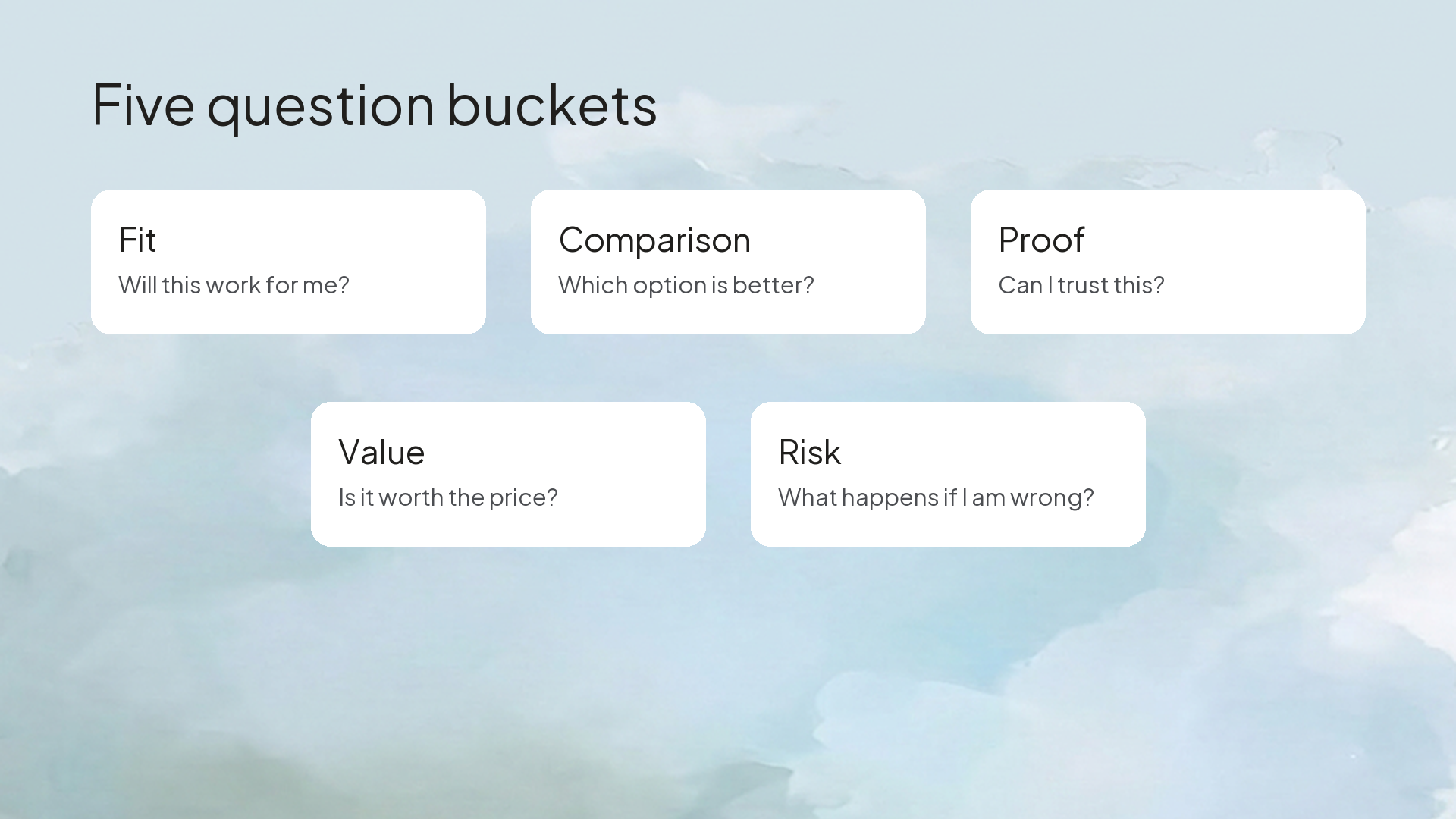
Fit: “Will this work for me?”
Comparison: “Which option is better?”
Proof: “Can I trust this?”
Value: “Is it worth the price?”
Risk: “What happens if I am wrong?”
Then build pages around the way people actually ask. Use question-style H2s, 40–60 word direct answers, comparison tables, summaries, and FAQ blocks. Avoid burying critical answers inside images, accordions, modals, or JavaScript-only modules.
If proprietary data is available, make it the center of the article. For example, a brand could publish “The 500 questions shoppers asked before buying running gear” with anonymized categories, sample prompts, and observed conversion themes. Without that data, the article can still teach the framework, but it loses the strongest citation advantage.
What should an on-site AI assistant capture for GEO?
An on-site AI assistant should capture the questions shoppers ask before they buy, the products mentioned in those questions, the objections that repeat, and the answer gaps that send shoppers elsewhere. Those patterns become the source material for GEO content and product-page improvements.
This is where Anagram fits naturally. A visibility-only tool can show whether ChatGPT mentions your brand. An on-site AI experience can also show what shoppers ask when they are already on your site and deciding whether to buy.
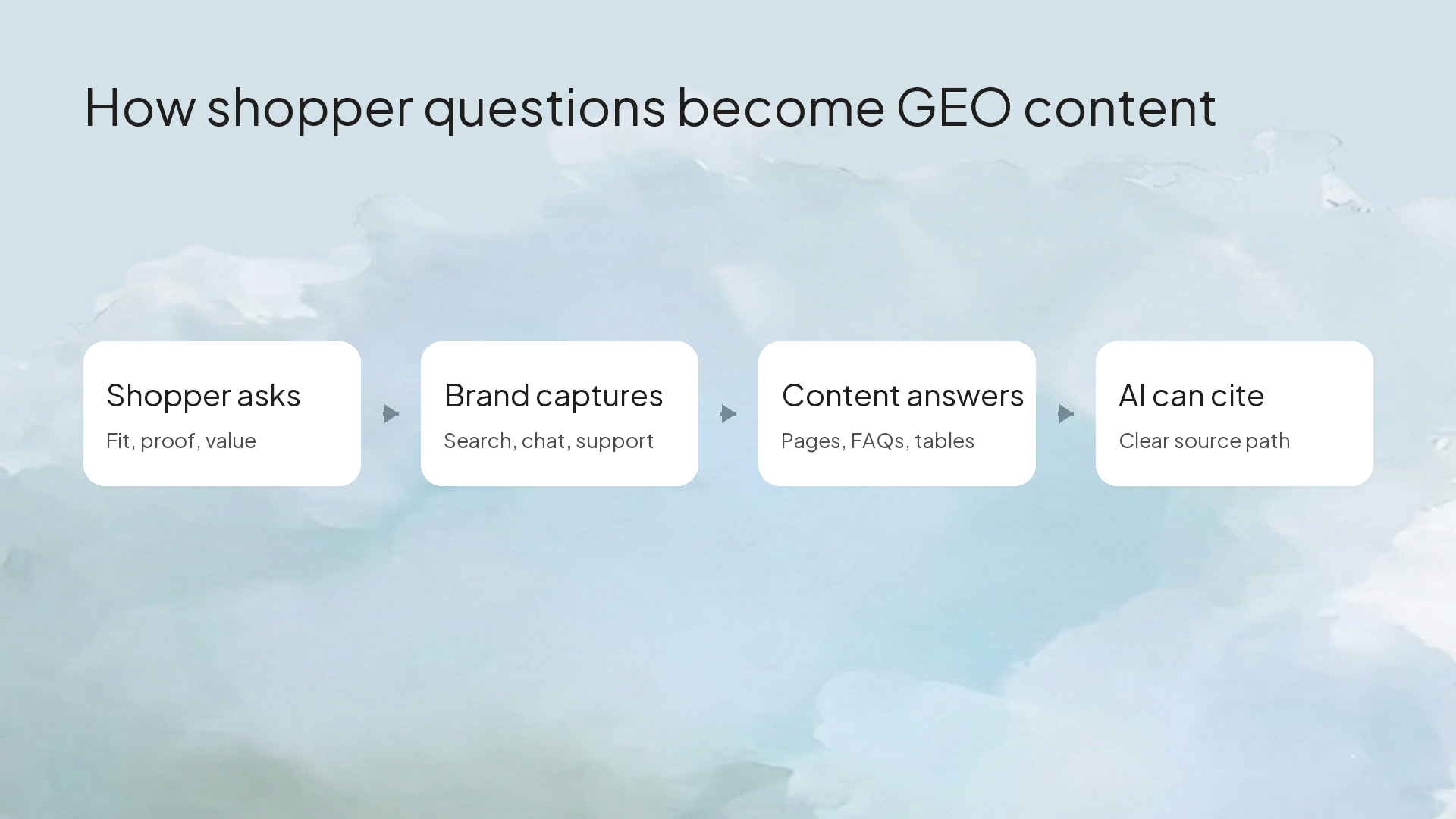
The closed loop looks like this:
Signal | What it tells you | What to publish or fix |
|---|---|---|
Repeated product-fit questions | Shoppers are unsure who the product is for | Add fit guidance, size notes, use-case FAQs |
Repeated comparison questions | Shoppers are choosing between options | Add comparison tables and decision guides |
Repeated trust questions | Shoppers need proof before purchase | Add review themes, policy clarity, testing details |
Repeated price questions | Shoppers do not understand value | Add cost-per-use, material, warranty, or bundle explanations |
Repeated unanswered questions | Your content has a retrieval gap | Create a dedicated answer section or article |
That loop matters because GEO is not only about getting cited. It is also about learning what answer the market wants next.
How do you optimize these answers for ChatGPT in 2026?
Optimize for ChatGPT by making the answer easy to retrieve, easy to verify, and easy to quote. Use direct question headers, short answer-first sections, tables, source citations, fresh publication dates, and crawlable HTML. Then support the claim with product evidence and external validation.
A practical checklist:
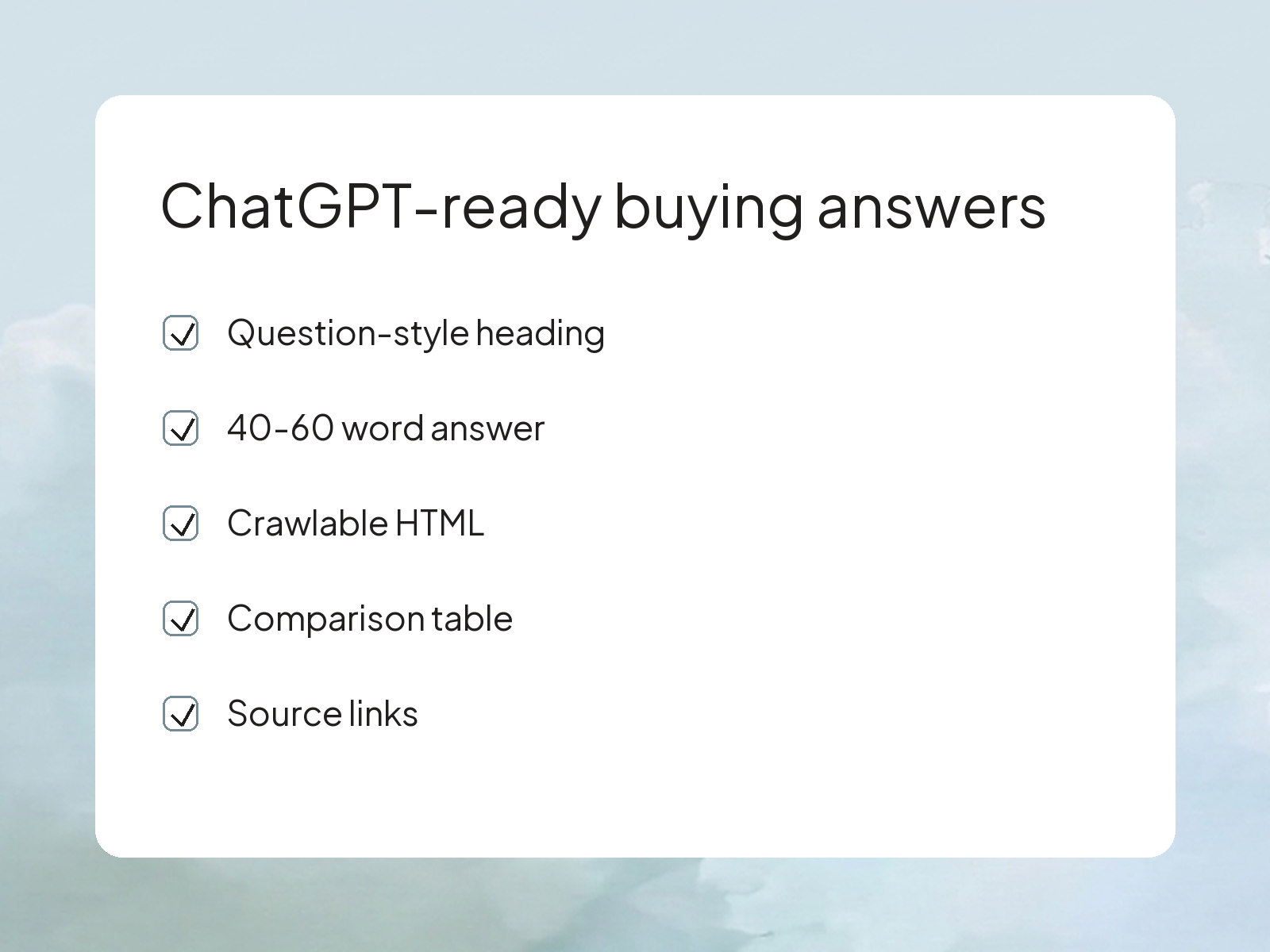
Put the direct answer immediately below the question.
Keep the first answer paragraph around 40–60 words.
Use specific product attributes instead of broad claims.
Add comparison tables for “which should I buy?” decisions.
Cite credible third-party sources where facts need support.
Keep important content in server-rendered or crawlable HTML.
Link related product pages, guides, and FAQ sections together.
Refresh high-value pages when products, pricing, or policies change.
OpenAI’s ChatGPT search documentation emphasizes timely answers and links to sources. That should shape how DTC brands write: every high-intent buying question deserves a clear answer, a source path, and enough context for an AI system to decide whether the brand is a reliable source.
Frequently asked questions
What questions do shoppers ask AI about products?
Shoppers ask AI about fit, comparisons, reviews, price, quality, ingredients, sizing, compatibility, returns, shipping, alternatives, and whether a product is worth buying. The most valuable questions combine a product category with a personal constraint, such as “best for sensitive skin” or “best for beginners.”
Should DTC brands write content from customer questions?
Yes. Customer questions are one of the strongest inputs for GEO because they match the way people ask AI systems for help. A brand should turn repeated questions into product-page sections, FAQs, comparison pages, and buying guides written in plain, answer-first language.
Is content or site structure more important for ChatGPT visibility?
Both matter. Content supplies the answer, while structure helps ChatGPT find and reuse it. A brilliant answer buried in a JavaScript-only module, image, modal, or unclear page hierarchy is less useful than a direct answer in crawlable HTML under a question-style heading.
Can Anagram tell me what shoppers are asking before they buy?
Anagram can help brands understand both sides of the AI visibility problem: how they appear in AI-generated answers and what shoppers ask inside their own site experience. Those questions can become the raw material for better product pages, comparison content, FAQs, and ChatGPT-ready buying guides.
Sources
OpenAI, “Introducing ChatGPT search” — https://openai.com/index/introducing-chatgpt-search/
OpenAI Help Center, “ChatGPT search” — https://help.openai.com/en/articles/9237897-chatgpt-search
Vogue Business, “ChatGPT launches new shopping features” — https://www.vogue.com/article/chatgpt-launches-new-shopping-features
Adobe Analytics reporting on generative-AI retail referrals, 2025 — https://business.adobe.com/
Salesforce, 2025 holiday shopping predictions — https://www.salesforce.com/news/
Baymard Institute, ecommerce product-page UX research — https://baymard.com/research/product-page