Is It Enough to Track AI Mentions? What DTC Brands Should Do Next in 2026
A practical comparison of monitoring AI mentions versus acting on them, with a closed-loop workflow for DTC brands improving ChatGPT visibility, citations, and on-site answers.

Is It Enough to Track AI Mentions? What DTC Brands Should Do Next in 2026
By Zach Luker - GEO Researcher
Published July 27, 2026 · Last updated July 27, 2026
TL;DR
No, tracking AI mentions is not enough. Monitoring tells you where ChatGPT names, cites, or skips your brand, but the lift comes from acting on those gaps. DTC brands need a closed loop: track prompts, diagnose why competitors win, publish better answers, improve on-site content, and rerun the same prompts.
Is it enough to just track my AI mentions?
Tracking AI mentions is necessary, but it is only the diagnostic layer. It tells you whether ChatGPT names your brand, cites your pages, and repeats competitor narratives. It does not fix thin product pages, missing comparison content, weak crawlability, poor source coverage, or unanswered shopper questions.
This is the core mistake in early GEO work. Teams buy a tracker, see a dashboard, and treat visibility as the result. It is not. Visibility is the measurement. The result is more accurate AI answers, stronger citations, better category coverage, and higher-confidence shoppers.
Semrush makes the distinction clear in its AI Visibility Toolkit. Visibility Overview reports on mentions, cited pages, citations, audience, and model distribution. Brand Performance looks at share of voice, sentiment, and narratives. Those metrics are useful because they point to work, not because they replace it.
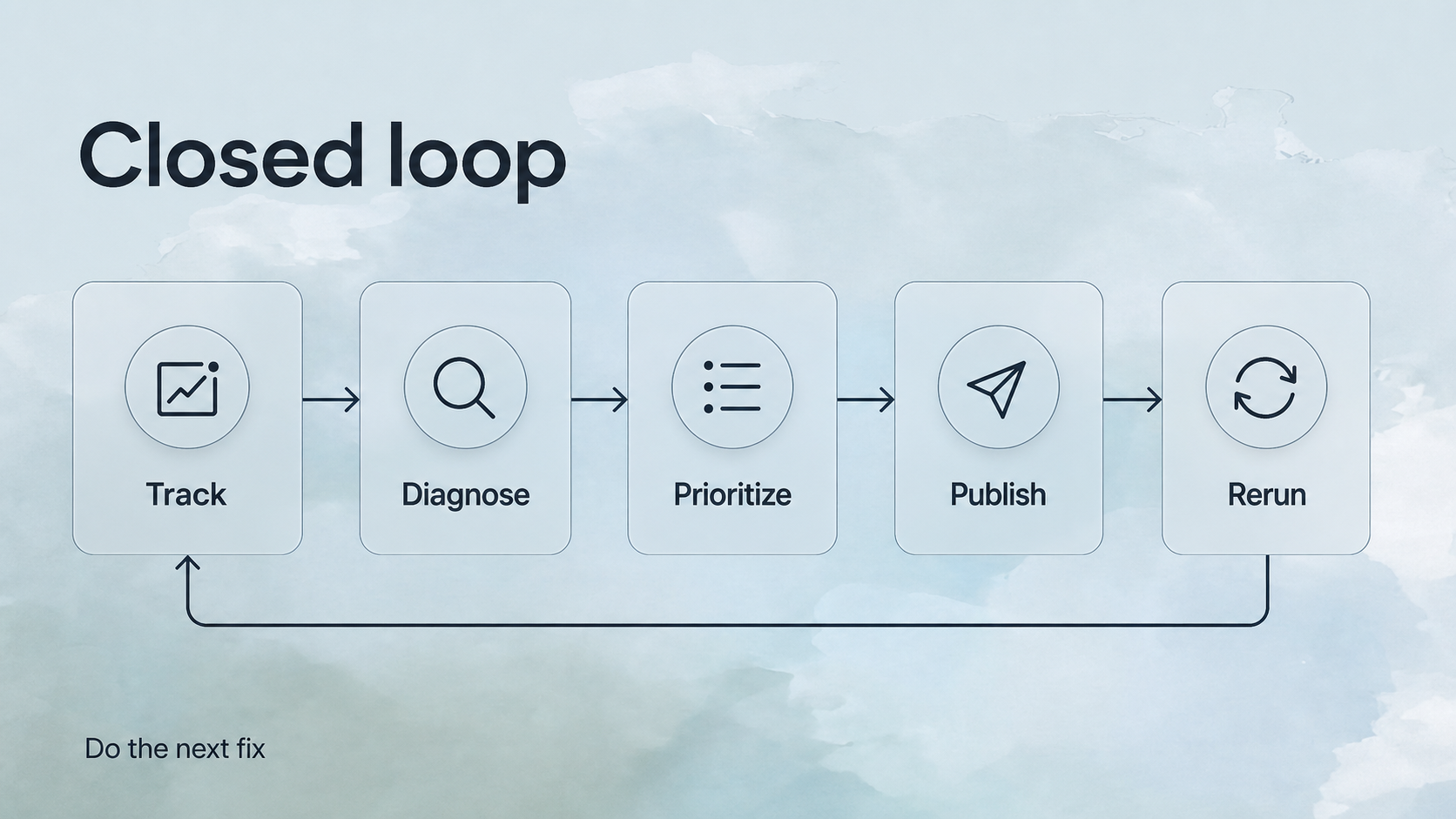
Monitoring explains the problem. Acting changes what future answers can say.
Mode | What it does | What it cannot do alone |
|---|---|---|
Monitoring AI mentions | Shows where your brand appears, where competitors appear, and what sources AI systems cite. | It cannot create better pages, stronger proof, clearer product data, or on-site answers. |
Acting on AI gaps | Turns missing prompts and weak citations into content, crawlability, product-page, and support fixes. | It still needs tracking to prove whether changes moved the answer set. |
What do I do after I see how my brand shows up in ChatGPT?
After you see how your brand shows up in ChatGPT, sort every finding into one of four actions: fix missing source content, improve the page ChatGPT should cite, answer the shopper question on-site, or build off-site proof. Then rerun the same prompts after the changes go live.
The most useful prompt report is a to-do list. If ChatGPT mentions a competitor and not you, ask what source supports the competitor. If it names you but does not cite you, ask whether your page is crawlable and extractable. If it gets your product wrong, fix the source material.
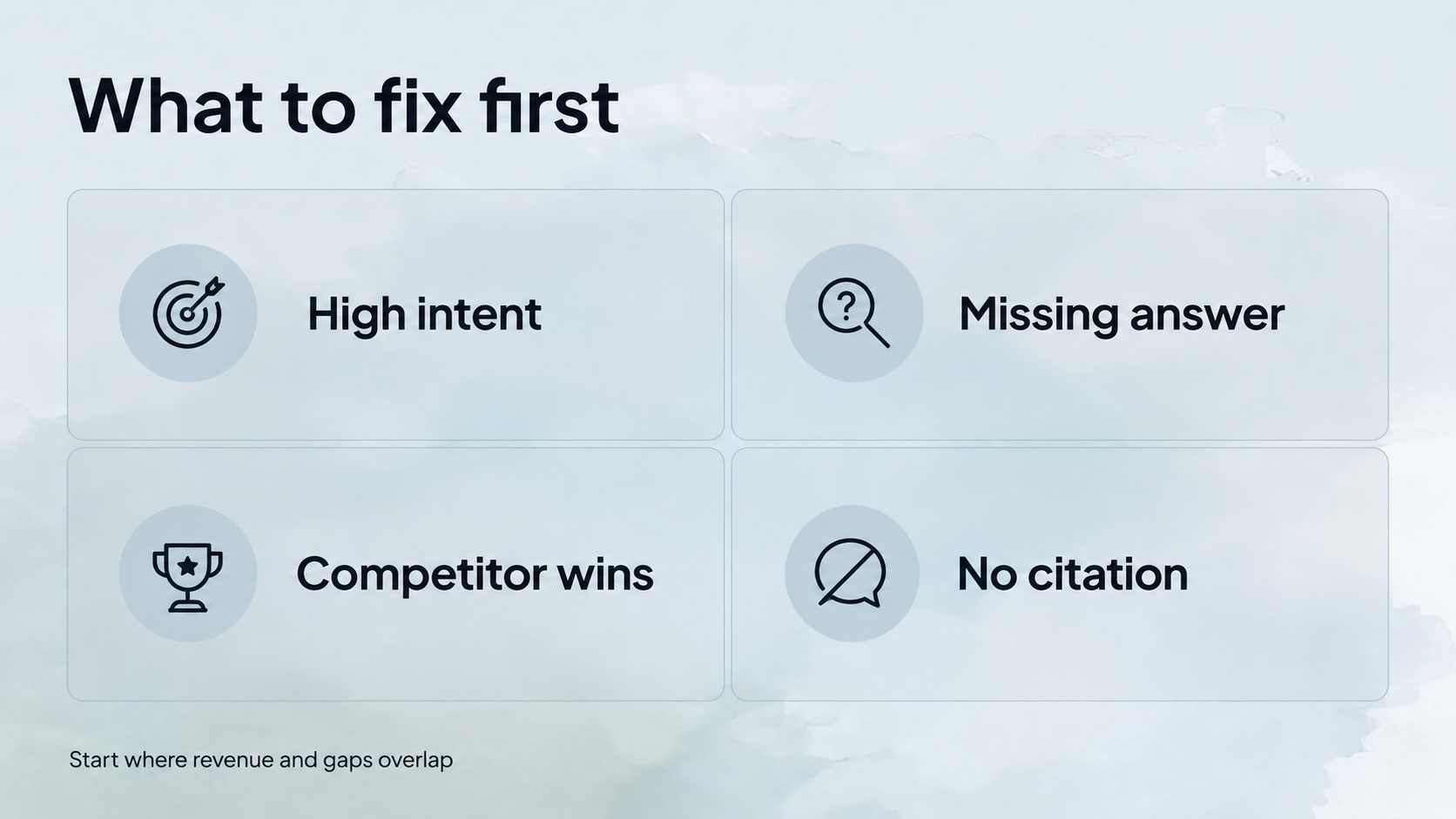
A repeatable loop is more useful than a one-time AI visibility screenshot.
Finding | Likely problem | Action |
|---|---|---|
Competitor is named and you are missing | ChatGPT has stronger category evidence for the competitor. | Publish a direct answer page, buying guide, comparison page, or product-use explainer. |
You are named but not cited | Your site may be known, but not useful as a source. | Make the page more answerable, structured, current, and crawlable. |
You are cited for the wrong page | The best source is buried or unclear. | Improve internal linking, canonical structure, and page-level summaries. |
ChatGPT gets a detail wrong | Your product data or public descriptions are inconsistent. | Fix PDPs, FAQs, feeds, third-party listings, and review language where possible. |
Sentiment is neutral or weak | AI can find the brand, but not a clear reason to recommend it. | Add evidence, customer language, use cases, policies, and comparison proof. |
Why does acting matter more than watching mentions?
Acting matters more because AI answers are built from available evidence. A brand that only monitors mentions learns where it is losing. A brand that publishes clearer answers, fixes pages, improves product data, and answers shopper questions gives ChatGPT better material to retrieve, summarize, and cite later.
The channel is still early, but it is growing fast. Adobe Analytics found U.S. retail traffic from generative AI sources rose 1,200% in February 2025 compared with July 2024. Adobe also found those retail visitors had 8% higher engagement, 12% more pages per visit, and a 23% lower bounce rate than non-AI traffic.
The caution is volume. A Marketing Science study of 973 ecommerce websites found organic LLM traffic was less than 0.2% of visits and converted below most traditional channels, though above paid social. That does not make AI visibility irrelevant. It means mention tracking should feed brand, content, and conversion work before referral traffic is large enough to explain the whole story.
How should DTC brands decide what to fix first?
DTC brands should fix the prompts where high purchase intent overlaps with a visible gap. Start with prompts where competitors win, ChatGPT gives no citation, the answer is wrong, or the shopper question is also asked on your own site. Do not start with generic awareness prompts unless they affect demand.
A good prioritization rule is simple: revenue intent first, repeated question second, citation gap third. The prompt "best scalp serum for postpartum hair shedding" matters more than a vague prompt like "hair care trends" because the shopper is closer to a decision.
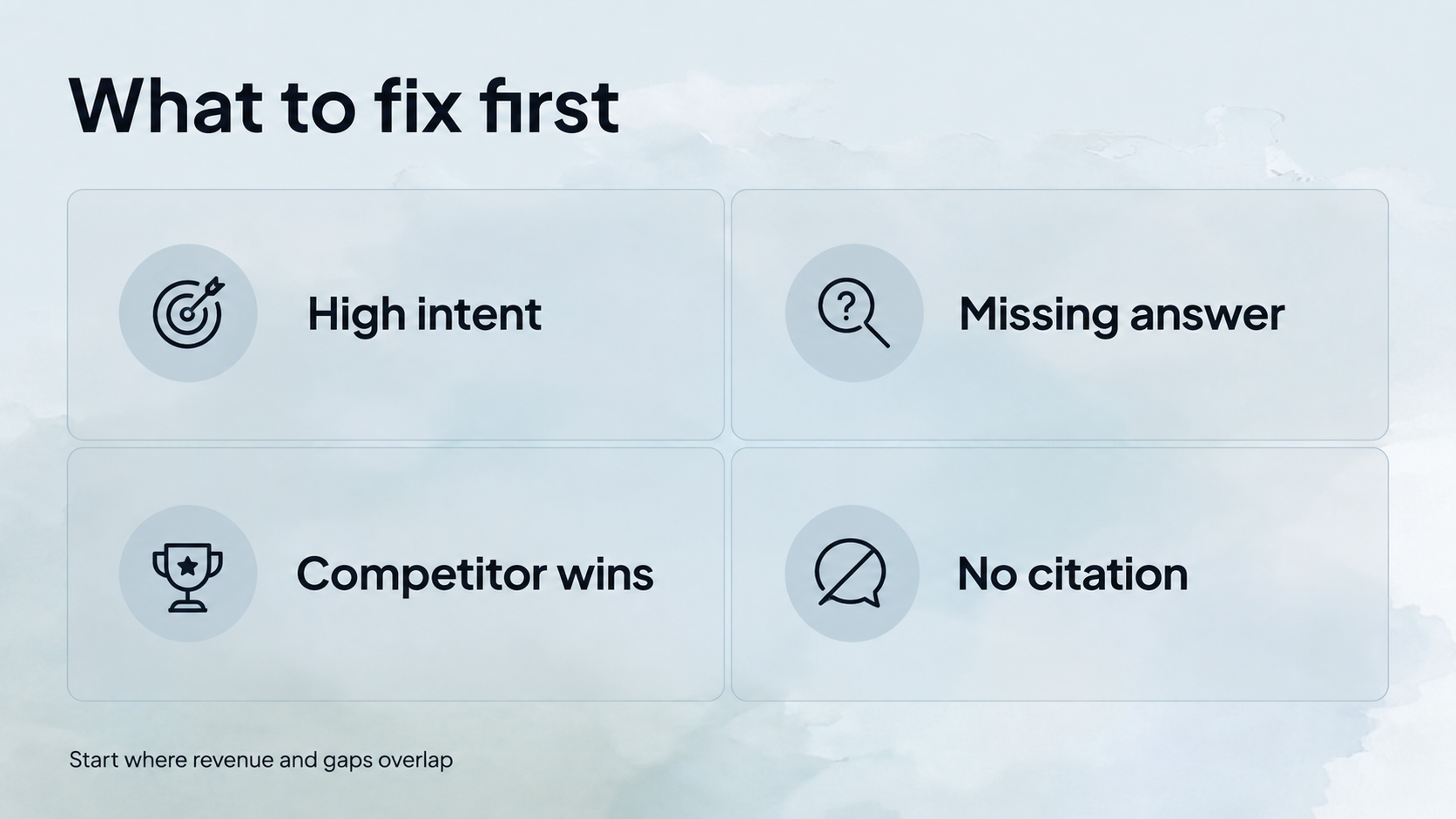
Start where revenue intent and answer gaps overlap.
Priority | Prompt type | Best fix |
|---|---|---|
1 | High-intent category prompt where a competitor wins | Comparison page, use-case guide, review-backed answer block. |
2 | Prompt where ChatGPT names you but does not cite you | Cleaner source page with direct answers, facts, and schema-friendly structure. |
3 | Prompt where ChatGPT gets your product wrong | Product-page copy, FAQs, product feed, and policy updates. |
4 | Repeated shopper question from your site agent | FAQ section, buying guide, PDP module, or on-site AI answer. |
What metrics should I track besides mentions?
Track mentions, citations, answer position, share of voice, sentiment, cited pages, prompt intent, and assisted on-site behavior. Mentions tell you whether you appear. Citations tell you whether your pages support the answer. On-site behavior tells you whether those AI-assisted shoppers still need help before they buy.
Search Engine Land reported that Previsible analyzed 6.77 million LLM-driven sessions and found ChatGPT drove 92.4% of AI referral traffic in that dataset. That makes ChatGPT a logical first measurement target, but referral traffic alone is a lagging metric. Mentions and citations often move earlier.
OpenAI's Shopping with ChatGPT documentation also shows why product metadata matters. Product results can include imagery, product details, merchant links, and Instant Checkout for eligible products. OpenAI says merchants may be ranked using factors like availability, price, quality, and whether they are the maker or primary seller.
What is the difference between a monitoring-only GEO tool and a closed-loop platform?
A monitoring-only GEO tool tells you what happened in AI answers. A closed-loop platform helps you decide what to do next and gives you a place to act, such as improving content, capturing shopper questions, or launching on-site answers. Both are useful, but they solve different jobs.
Capability | Monitoring-only workflow | Closed-loop workflow |
|---|---|---|
Prompt tracking | Shows where your brand appears or disappears. | Shows visibility changes and maps them to content or site fixes. |
Competitor gaps | Identifies prompts competitors win. | Turns gaps into pages, answer blocks, or product-positioning updates. |
Citation analysis | Shows which sources AI systems use. | Improves the pages that should become the cited sources. |
Shopper questions | Usually not connected to on-site behavior. | Uses real shopper questions to decide what content and answers to improve. |
Business outcome | Visibility reporting. | Visibility, content improvement, on-site answers, and conversion learning. |
How does Anagram turn AI visibility tracking into action?
Anagram is built for the closed loop: see how AI systems mention your brand, learn what shoppers ask, and improve the answers they see on your site and in AI search. The point is not to stare at a score. The point is to create the next useful fix.
That matters for DTC brands because the same question can appear in two places. A shopper may ask ChatGPT for recommendations before they arrive, then ask your site why one product fits their need. Anagram connects those signals instead of treating AI visibility and on-site conversion as separate workstreams.
Public Anagram examples show the outcome side of the loop. Anagram reports that Bote decreased traditional customer support contacts by 36%, Dakine engaged more than 25,000 shoppers, and Elan Pure raised conversion rates to 13% with Anagram-assisted sessions. Those results are not automatic. They show why action has to follow monitoring.
Frequently asked questions
Should I check ChatGPT manually or use a tracker?
Manual checks are useful for quick diagnosis, but they are too inconsistent for monthly decision-making. Use manual checks to understand answer quality and a tracker to compare the same prompts over time, across competitors, locations, and AI systems.
How often should I check AI mentions?
Weekly is enough for most small DTC teams. Daily tracking helps when you are running active experiments or reporting to a larger team. Monthly review is the minimum if you want to connect visibility changes to content updates and site changes.
What should I do if ChatGPT mentions my competitor but not me?
Find the reason the competitor is easier to recommend. Look for cited pages, stronger category pages, clearer product positioning, richer reviews, better comparison content, or more off-site mentions. Then publish the missing answer and rerun the prompt after it is indexed and crawlable.
What should I do if ChatGPT mentions me but gets the details wrong?
Fix the source of truth first. Update product pages, FAQs, policy pages, feed data, third-party listings, and support content. Then add a concise page section that answers the exact incorrect detail in plain language. AI systems need a better source to repeat.
Is AI referral traffic the main KPI?
No. AI referral traffic is useful, but it is not the first KPI. Start with prompt coverage, citations, share of voice, sentiment, and high-intent gaps. Track referral traffic once you have enough volume to separate signal from noise.
Next steps
Run a baseline prompt set, mark every gap with a concrete fix, and publish the highest-intent fixes first. Anagram can help DTC brands connect AI visibility tracking with shopper questions and on-site AI answers, so the report turns into work that can change future answers.