How AI Search Is Changing E-Commerce Discovery in 2026
AI search is moving product discovery into conversational AI answers, where fewer but higher-converting shoppers arrive—so brands must win the answer itself, the problem Anagram is built to solve.

TL;DR
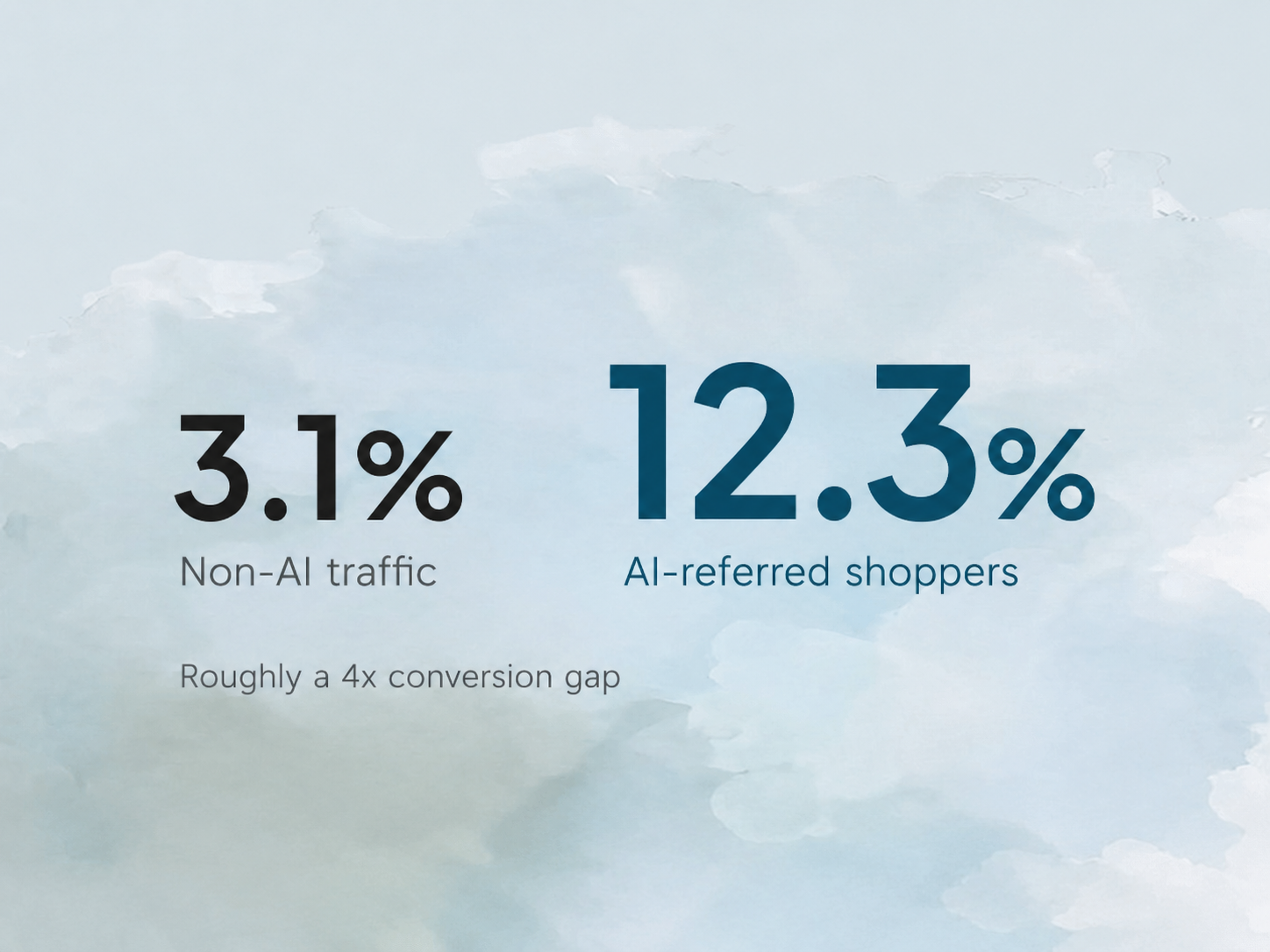
AI search is moving product discovery off the search results page and into conversational answers. Shoppers now ask ChatGPT, Gemini, and Perplexity to recommend, compare, and find products directly. AI-referred shoppers convert at roughly 12.3% versus 3.1% for traditional traffic, so winning the answer matters more than ranking the link.
What is AI search in e-commerce?
AI search in e-commerce is product discovery that happens inside generative AI systems — ChatGPT, Google's AI Overviews and AI Mode, Perplexity, Gemini — where the assistant answers a shopper's question directly and recommends specific products instead of returning a page of links.
The shift is from retrieval to synthesis. A traditional search engine hands back ten blue links and lets the shopper sort it out. An AI answer engine reads the query, pulls from many sources, and returns a single composed recommendation — often naming a product or brand outright. The brand's goal changes accordingly: not ranking among links, but being the source the model cites.
This is why the discipline of optimizing for these systems has its own name — Generative Engine Optimization (GEO), sometimes called Answer Engine Optimization (AEO). The win condition is being named or quoted in the answer itself.
How does AI search change the way shoppers discover products?
AI search collapses the discovery funnel. Instead of searching, opening tabs, comparing, and reading reviews across sites, a shopper describes what they need in plain language and the assistant returns a filtered, reasoned recommendation. The shopper arrives at a product already informed and pre-qualified.
Conversational, intent-rich queries replace keywords
Shoppers no longer type "running shoes." They ask "what are the best stability running shoes for flat feet under $150 that don't run narrow." AI systems handle that full sentence and match it to specific products, which means discovery now rewards content that answers complete questions, not pages stuffed with keywords.
Zero-click discovery becomes the norm
When an AI Overview appears, organic click-through can drop sharply, and a large share of AI-mode sessions end without the shopper visiting any external site at all. When an AI Overview appears, organic click-through rates drop by 61% according to BrightEdge search data, and in Google's AI Mode, 93% of sessions end without the user visiting any external website. The brand may influence the purchase without ever getting the visit, so being cited inside the answer is the only way to participate.
The traffic that does arrive is dramatically better
AI-referred shoppers behave differently from search or social traffic. They arrive already filtered by an assistant that understood the query. AI-referred shoppers spend 45% more time exploring products than visitors from paid search, email, organic, or social, and they convert at 12.3% versus 3.1% for non-AI-assisted shoppers — roughly a 4x conversion gap. On Shopify specifically, AI-referred shoppers convert at nearly 50% higher rates and carry 14% higher average order values than organic search.
Visual and voice discovery expand the surface
Discovery is no longer text-only. Visual search is growing roughly 70% globally, and Amazon alone receives around 4 billion shopping-related visual searches per month through Google Lens. 37% of global shoppers now make voice-enabled purchases online. Each new interface is another place a product either surfaces or stays invisible.
Why does AI search matter for e-commerce brands right now?
It matters because the channel is large, fast-growing, and higher-converting than anything that came before it — and because the brands optimizing for it now are capturing share while others stay invisible.
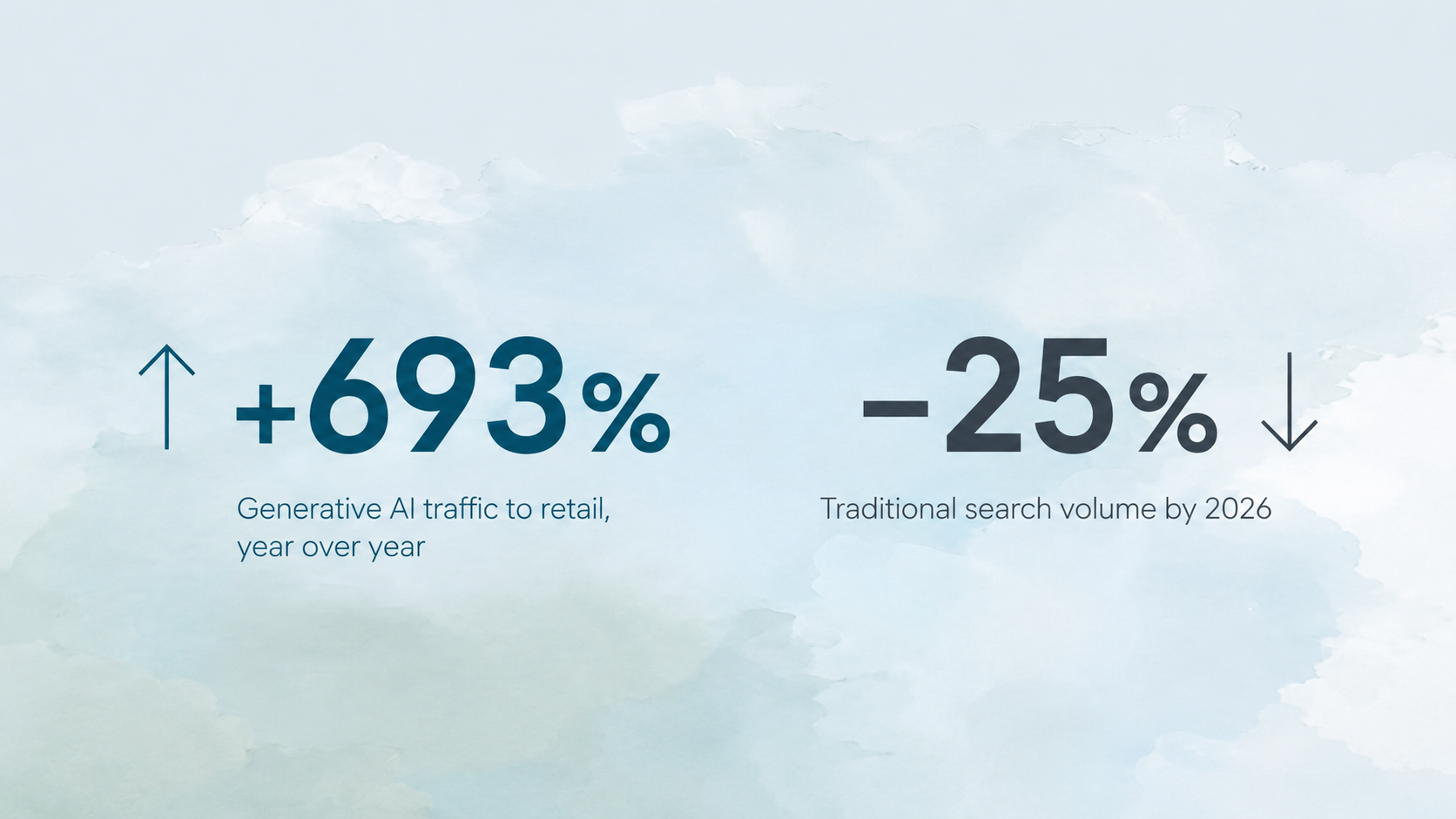
The growth is not incremental. Traffic from generative AI to retail sites surged 693% year-over-year during the 2025 holiday season, tracked across more than 1 trillion retail visits by Adobe Analytics. Looking forward, Gartner estimates traditional search-engine volume will fall 25% as users migrate to generative AI chatbots and other virtual agents. Gartner's analyst framed the cause directly:
"Generative AI solutions are becoming substitute answer engines, replacing user queries that previously may have been executed in traditional search engines."
— Alan Antin, Vice President Analyst, Gartner
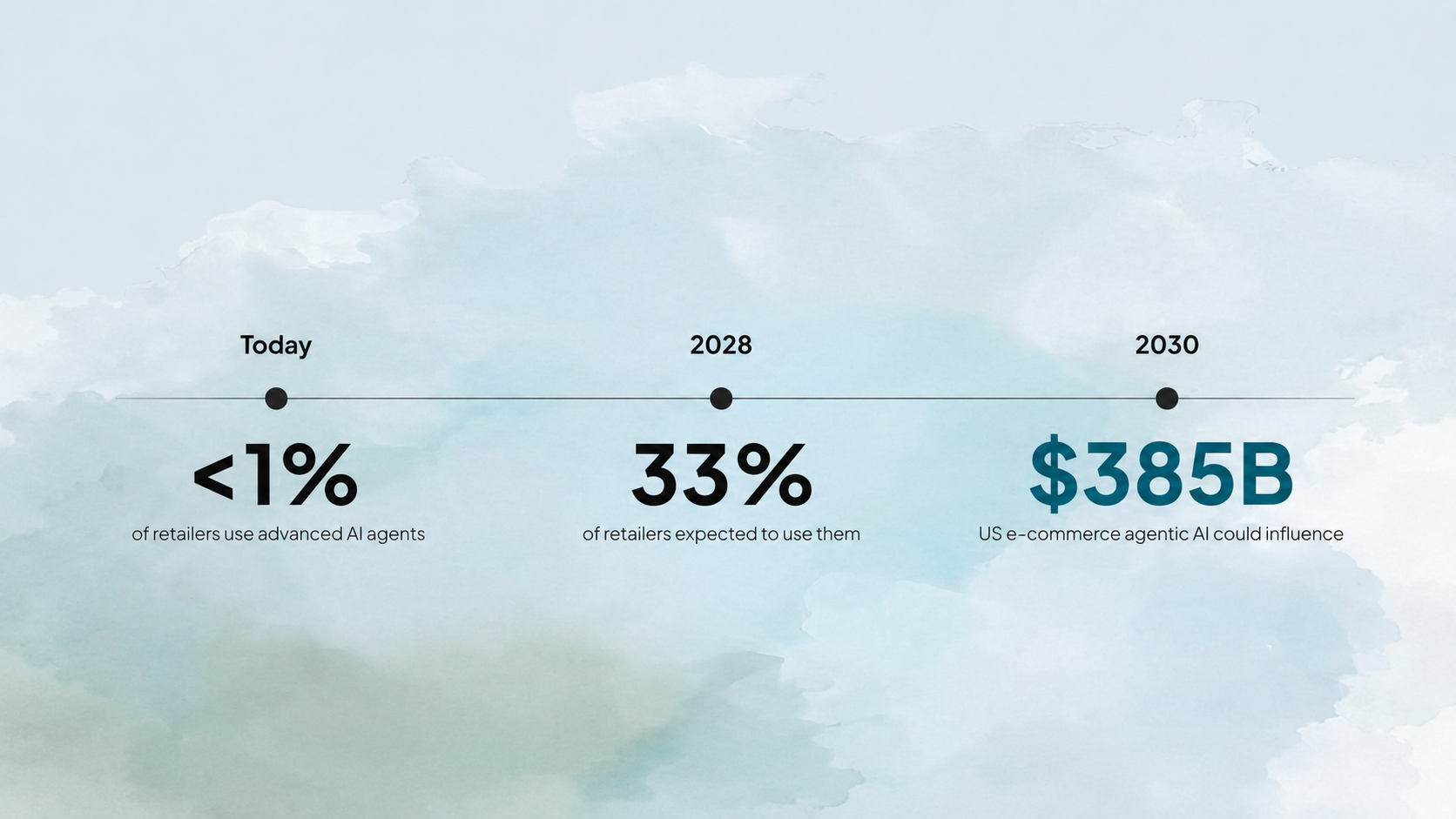
The agentic layer is coming next. By 2028, roughly 33% of online retailers are expected to use advanced AI agents, up from under 1% today, and Morgan Stanley projects agentic AI could influence up to $385 billion of US e-commerce by 2030. And confidence — not just convenience — is driving adoption: Adobe found that 65% of consumers who use AI for online shopping feel more confident in their purchase decisions, and AI-assisted shoppers are 68% less likely to return items.
Common use cases already in production:
Conversational product Q&A — shoppers asking sizing, compatibility, and "will this work for me" questions and getting instant, accurate answers.
Guided recommendations — the assistant narrows a catalog to a few products based on stated needs and constraints.
Comparison and deal discovery — AI scanning retailers, promotions, and historical pricing to surface the best fit and price.
Voice and visual lookup — finding a product from a photo or a spoken description rather than a typed keyword.
What do brands need to do to stay discoverable?
The brands capturing AI-driven discovery are investing in what these systems actually consume: accurate, structured, complete product data; authentic review ecosystems; and content that answers the questions shoppers ask before they decide.
That breaks into two distinct, complementary jobs:
The job | What it means | What it produces |
|---|---|---|
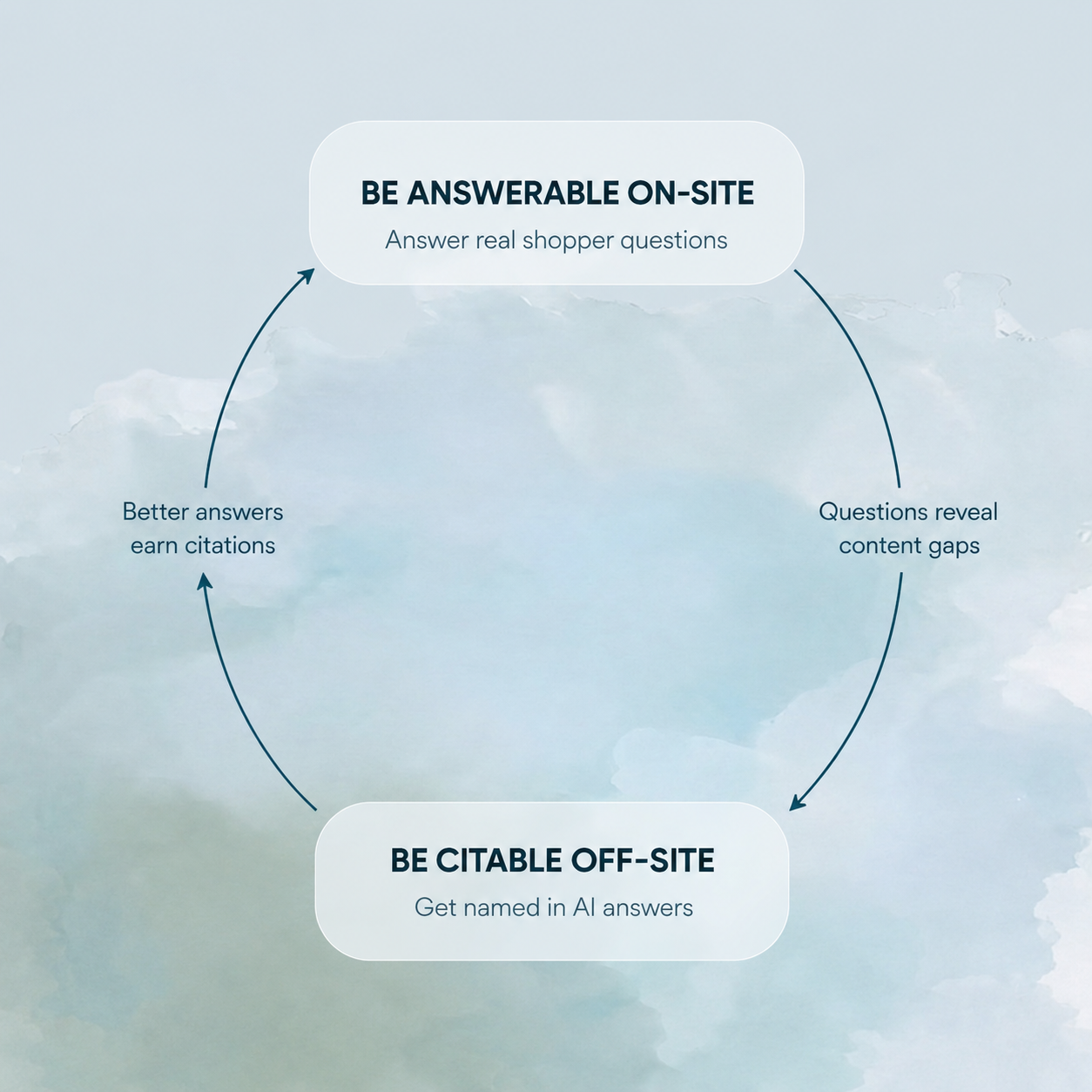
Be answerable on-site | Help every shopper who arrives get their real questions answered and find the right product | Higher conversion, plus a live record of what shoppers actually ask |
Be citable off-site | Make sure AI engines name and recommend your products in their answers | Share of synthesis — presence inside AI-generated recommendations |
The two jobs feed each other. The questions shoppers ask on your own site are the clearest possible map of the content gaps that keep you out of AI answers. Close those gaps and your off-site visibility improves.
Structure your product data for machines
AI systems favor machine-readable catalogs — clean schema markup, structured feeds, and complete attributes. Retailers whose catalogs aren't structured for machine readability risk becoming invisible to the fastest-growing commerce channel, which is the practical definition of GEO/AEO readiness.
Answer real questions in your content
AI systems doing retrieval match a shopper's query to a chunk of content. Pages built around the actual questions shoppers ask — with clear, direct answers — are far more retrievable than keyword pages. The most reliable source of those questions is your own shoppers.
Track whether AI engines actually cite you
You can't improve what you can't see. Testing your priority queries in ChatGPT and checking whether your brand appears, and how it's described, turns AI visibility from a guess into a measurable metric.
How can Anagram help you adapt to AI-driven discovery?
Anagram (anagram.ai) is built around exactly this two-sided problem — being answerable on-site and citable off-site — and connects them through a single growth loop.
On the on-site side, Anagram adds a conversational AI agent to your site that answers customer questions, gives guided product recommendations, and helps shoppers find the right location or next step. It works on any brand and any website, so the same intent-rich, conversational discovery shoppers now expect from ChatGPT happens directly on your own storefront — where you keep the visit and the conversion.
On the AI visibility side, Anagram tracks whether and how AI engines surface your brand, currently focused on ChatGPT with additional engines on the roadmap. That turns "are we showing up in AI answers?" into something you can actually monitor.
The connection between the two is the differentiator. The on-site agent surfaces the real questions shoppers ask — questions that reveal exactly where your content and product data fall short. Address those gaps and your AI visibility improves. Better on-site answers feed better off-site citations, and the loop compounds. Anagram is one option in a growing category; its distinct angle is closing the loop between what shoppers ask you and what AI says about you, rather than treating on-site experience and AI visibility as separate problems.
Frequently asked questions
Is GEO the same as SEO?
No. SEO optimizes for ranking among links on a search results page. GEO optimizes for being named, quoted, or recommended inside an AI-generated answer. They share fundamentals like content quality and clean structure, but the win condition is different — and traditional SEO alone no longer covers AI-driven discovery.
Does AI search send less traffic than Google?
Often less raw traffic, but far higher quality. AI-referred shoppers convert at about 12.3% versus 3.1% for non-AI traffic. Fewer, more-qualified visitors who convert at roughly 4x can outperform a larger pool of low-intent clicks.
Do I need to optimize for AI search if I already do SEO?
Yes. Gartner's forecast of a 25% decline in traditional search volume reflects shoppers moving to answer engines, not asking fewer questions. SEO still provides a baseline — Gemini and AI Overviews correlate with traditional rankings — but it doesn't guarantee citation in conversational answers.
Which AI engines should I track first?
ChatGPT is the highest-leverage starting point given its query volume and commerce referral share. Google's AI Overviews and AI Mode matter because they sit inside the world's largest search product, and Perplexity matters for research-heavy categories. Start where your shoppers already are and expand.
Sources
Techverx — From Google to AI: How Ecommerce Discovery Is Changing in 2026
Shopify — AI-referred shoppers convert better and spend more (2026)
Adobe Analytics / Elogic Commerce — AI in Ecommerce Statistics 2026
Anchor Group — AI in E-Commerce: 16 Key 2026 Trends & Stats
Envive — Generative AI Commerce Adoption Statistics for Ecommerce 2026 (Adobe survey data)
Gartner — Search Engine Volume Will Drop 25% by 2026, Due to AI Chatbots and Other Virtual Agents
Morgan Stanley / Shopify — agentic commerce projections, via Elogic Commerce
Stord — State of AI in E-Commerce 2026