How Do I Get a Free ChatGPT Visibility Report for My Brand in 2026?
A practical guide to getting a free ChatGPT visibility report, what the report should include, and when a DTC brand should move from a one-time snapshot to ongoing AI visibility tracking.

How Do I Get a Free ChatGPT Visibility Report for My Brand in 2026?
By Zach Luker - GEO Researcher
Published July 28, 2026. Last updated July 28, 2026.
TL;DR
You can get a free ChatGPT visibility report by running your brand through a free AI visibility checker or by doing a focused manual prompt audit. The useful report is not just a score. It should show prompts, mentions, competitors, cited sources, and the first fixes to make.
How do I get a free ChatGPT visibility report for my brand?
Use a free AI visibility checker if you want a fast snapshot, or run a small manual audit if you want to understand the answers yourself. Start with your brand name, domain, category, and 10 to 20 buyer prompts. Then record whether ChatGPT mentions you, names competitors, and cites useful sources.
A free report is best for answering one basic question: are you visible at all when buyers ask ChatGPT about your category? It should not be treated like a full monitoring system. Most free reports are point-in-time checks. They help you spot obvious gaps before you spend money on a deeper workflow.
Free AI visibility tools have become common. Ahrefs, for example, describes its free checker as a way to see AI mentions across ChatGPT, Gemini, Perplexity, Copilot, and Google AI Overviews. Other free-report tools use similar language: enter a brand or domain, generate prompts, check mentions, and return a score or summary.
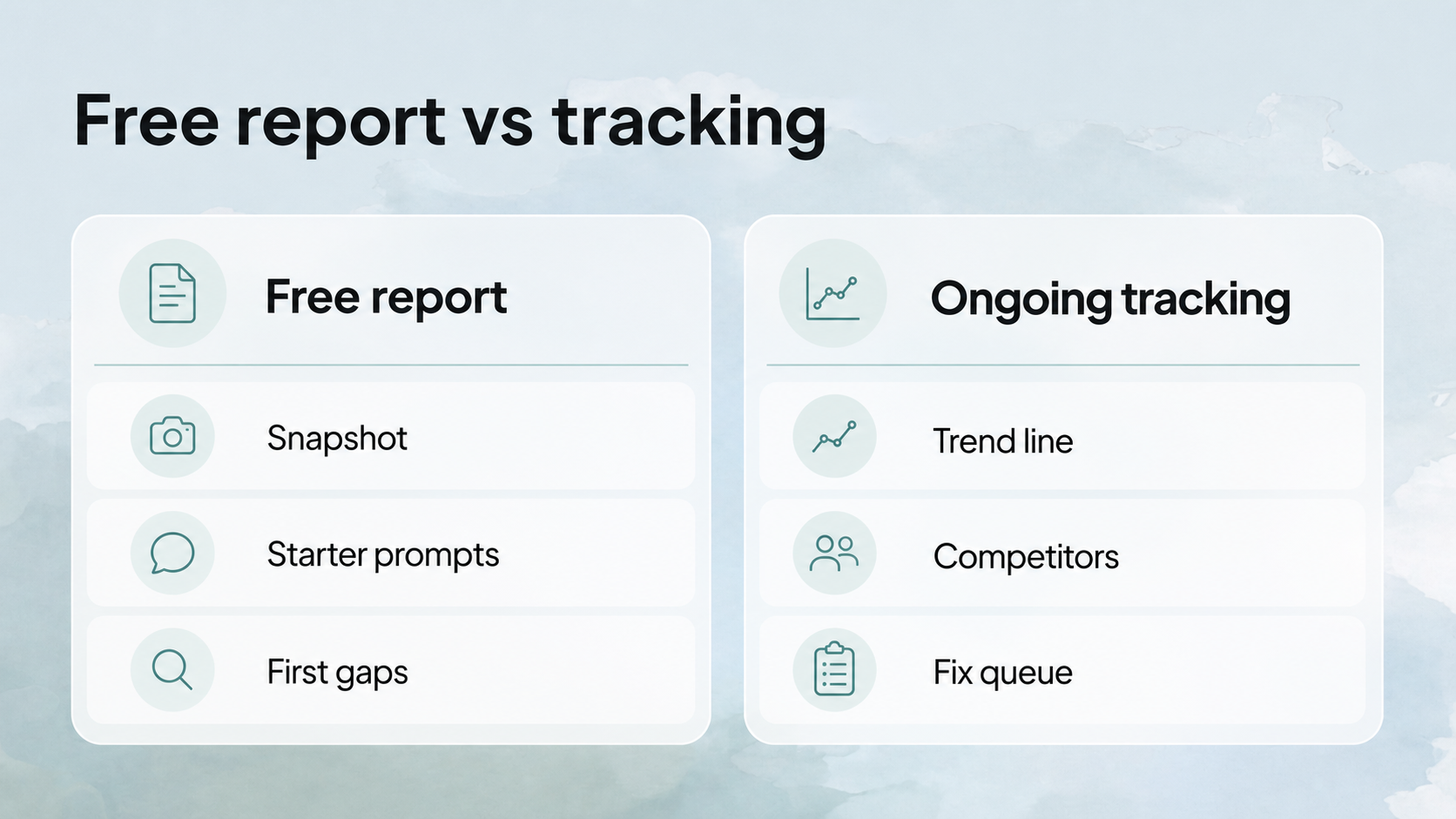
A free report gives you a first snapshot. Ongoing tracking tells you whether the fixes are working.
What should a free ChatGPT visibility report include?
A useful report should include the prompts tested, whether your brand appeared, which competitors appeared instead, what sources ChatGPT cited, and what to fix first. A score by itself is too thin. You need the evidence behind the score so your team can improve pages, sources, and answers.
At minimum, ask for five fields in the report:
Report field | Why it matters |
|---|---|
Prompt tested | You need to know which buyer question created the answer. |
Brand mention | This shows whether ChatGPT includes you in the consideration set. |
Competitor mentions | This shows who is winning the answer when you are absent. |
Cited sources | This shows which pages and publications shape the answer. |
Recommended fixes | This turns the report into a work queue instead of a vanity metric. |
Semrush frames its AI Visibility Score as a 0 to 100 benchmark that combines how often and how prominently a brand appears in AI-generated answers. Its documentation also separates mentions, citations, cited pages, competitors, countries, and LLM distribution. That is the right mental model. Visibility is a bundle of signals, not one number.
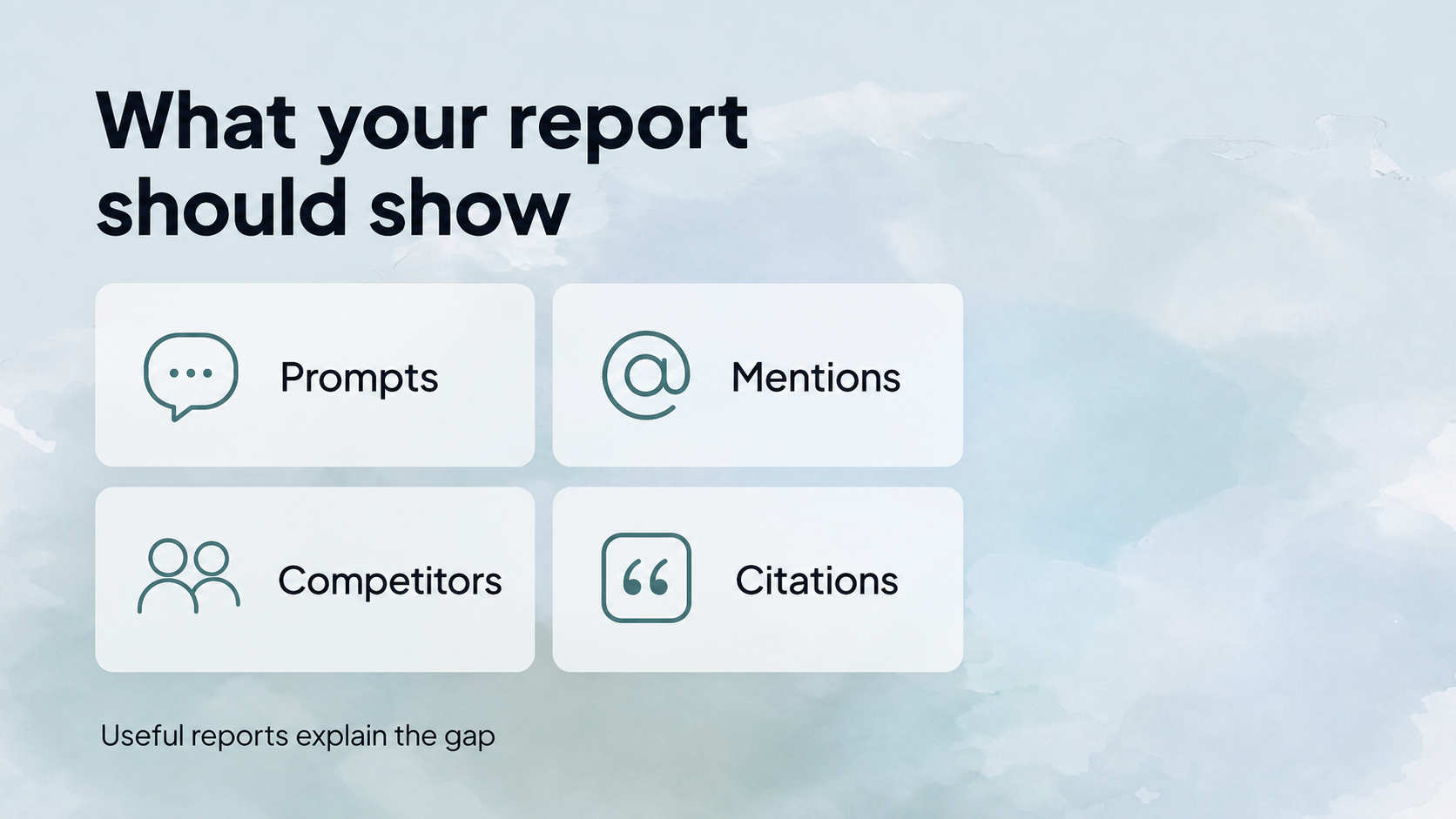
The report should make the gap explainable: prompts, mentions, competitors, and citations.
Can I check my brand's ChatGPT visibility manually?
Yes. A manual audit works if you only need a first read. Pick 10 high-intent prompts, ask ChatGPT in a fresh chat with search enabled, save the answer and sources, and mark whether your brand appears. Repeat the same prompt later to see whether the answer changes.
Manual checking has limits. ChatGPT answers can vary by wording, location, personalization, browsing state, and product changes. A single prompt result is not a durable ranking. Still, a manual pass is useful because it lets you read the exact language ChatGPT uses about your category.
Use this quick process:
Step | Action | Output |
|---|---|---|
1 | Pick 10 buyer prompts | A small prompt set tied to real purchase intent. |
2 | Ask ChatGPT each prompt | The answer, recommended brands, and any citations. |
3 | Log the result | Mentioned, cited, competitor-only, or absent. |
4 | Find the pattern | The pages, sources, and topics you need to improve. |
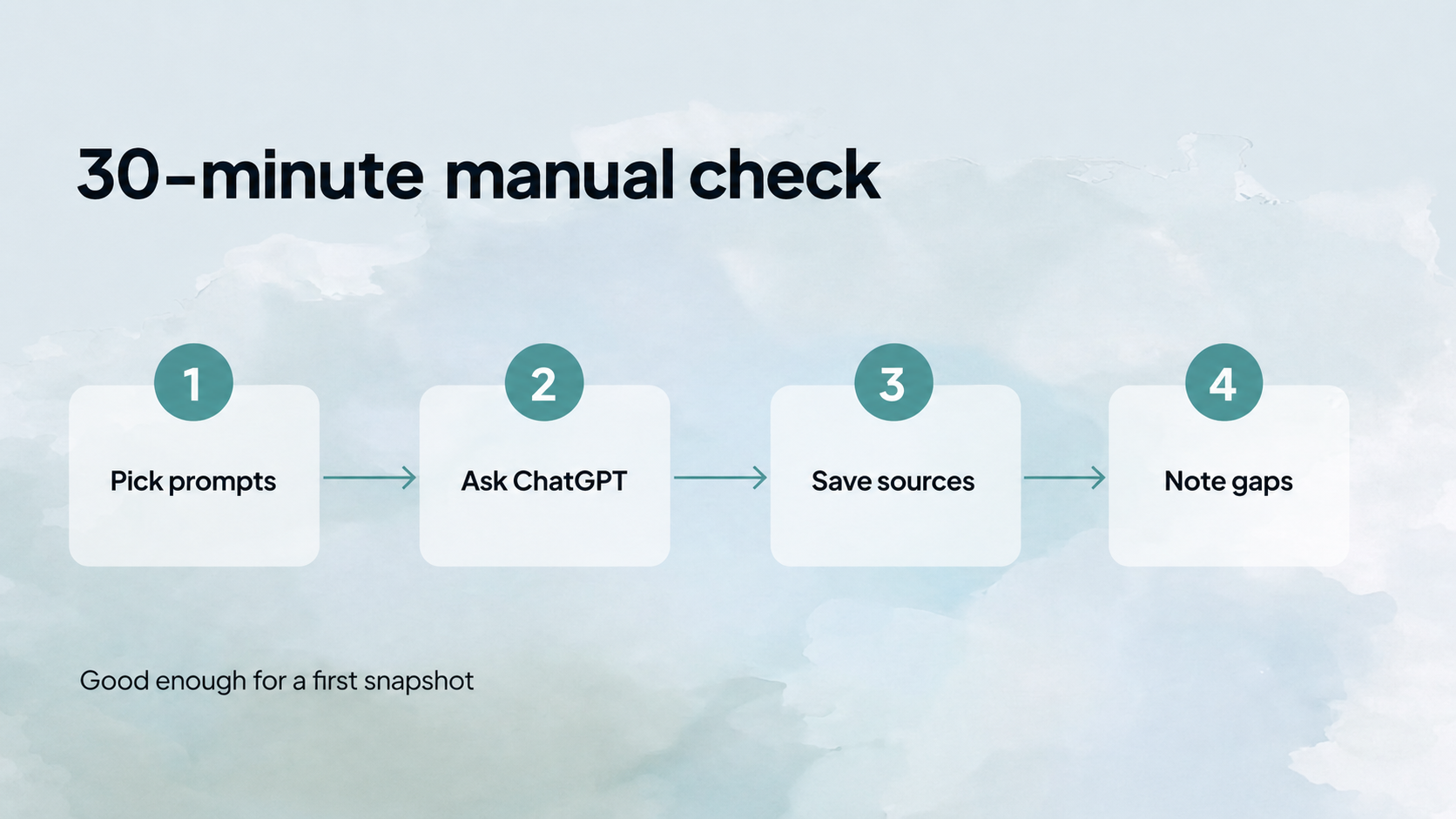
A manual audit is good enough for a first snapshot if the prompt set is specific.
Why does a ChatGPT visibility report matter for DTC brands?
It matters because ChatGPT is becoming a real research layer before shoppers reach your site. Adobe Analytics reported that generative AI traffic to U.S. retail sites rose 1,200 percent in February 2025 compared with July 2024, based on more than 1 trillion retail visits and a 5,000-person survey.
The same Adobe report found that 39 percent of surveyed consumers had used generative AI for online shopping, and that AI-referred retail visitors viewed 12 percent more pages with a 23 percent lower bounce rate than non-AI traffic. Those users often arrive more informed, even when the channel is still smaller than search or email.
A 2026 Marketing Science study gives a more cautious view. Researchers analyzed 973 ecommerce websites, more than 50,000 ChatGPT-referred transactions, and 164 million traditional-channel transactions. They found organic LLM traffic was still under 0.2 percent of visits and converted above paid social but below most traditional channels.
The practical takeaway is simple. AI visibility is not replacing your acquisition stack today. But it is becoming a measurable discovery path, especially for considered purchases where shoppers ask comparison, fit, sizing, and recommendation questions before buying.
What prompts should I use in a free visibility report?
Use prompts that mirror how buyers compare products, not generic brand-name checks. A good starter set covers category recommendations, alternatives, price, use cases, objections, and product-fit questions. Your goal is to see whether ChatGPT includes your brand when a buyer has not already decided on you.
For a DTC brand, start with prompts like these:
What are the best [category] brands for [use case]?
Which [category] should I buy if I care about [attribute]?
What is the difference between [your brand] and [competitor]?
Is [your brand] worth it compared with cheaper alternatives?
What [product] should I buy for [specific shopper situation]?
Which brands make the highest-quality [category] in 2026?
Do not stop at branded prompts like "What is [brand]?" Those are useful for checking factual accuracy, but they do not show whether ChatGPT recommends you to undecided buyers. The money is in non-branded prompts where a shopper asks for help choosing.
What is the difference between a free report and ongoing AI visibility tracking?
A free report shows where you stand at one moment. Ongoing tracking shows whether your visibility changes as ChatGPT, competitors, and your own content change. Use the free report to identify the first gaps. Use ongoing tracking when AI visibility becomes a recurring growth channel.
Need | Free report | Ongoing tracking |
|---|---|---|
First benchmark | Good fit | Also useful |
Competitor monitoring | Limited | Better fit |
Prompt trend history | Usually missing | Required |
Citation source tracking | Basic snapshot | Stronger pattern detection |
Fix prioritization | Sometimes included | Should be central |
Search Engine Land reported on Previsible's 2026 AI traffic study, which analyzed 6.77 million LLM-driven sessions across 166 GA4 properties. In that dataset, ChatGPT accounted for 92.4 percent of trackable standalone LLM referral traffic. That concentration is a reason to monitor ChatGPT closely, not a reason to ignore answer quality.
How does Anagram help after the first report?
Anagram helps DTC teams move from "we got a visibility score" to "we know what to fix next." It shows how your brand appears in ChatGPT, where competitors win, which sources shape the answer, and how shopper questions on your own site can feed better content and product answers.
The free-report stage is useful because it creates urgency. The next stage is where growth happens. You need to know which prompt clusters matter, which product questions are missing from your site, which pages ChatGPT can understand, and whether fixes improve future answers.
Anagram's public AI Visibility page describes the workflow as a loop: see where your brand shows up, understand where competitors win, identify topic gaps, and use customer questions to improve how AI systems understand and recommend your brand. That is the difference between reporting and operating.
When should I move from a free report to a paid tool?
Move to a paid tool when the report creates recurring work. If you need weekly tracking, competitor comparisons, citation-source history, prompt groups, or a fix queue for your team, a free snapshot will get stale quickly. If you are only validating whether the category matters, start free.
Use this rule of thumb:
Situation | Best next step |
|---|---|
You have never checked ChatGPT visibility | Run a free report or 30-minute manual audit. |
You appear for branded prompts only | Build pages for non-branded buyer questions. |
Competitors appear and you do not | Analyze their cited sources and answer structure. |
ChatGPT cites outdated or weak pages | Update content, internal links, and product details. |
You are publishing weekly | Track prompts over time so you can see movement. |
Frequently asked questions
Is a free AI visibility report accurate?
It can be directionally useful, but it is not a complete truth source. Accuracy depends on the prompt set, engines tested, location, crawl freshness, and whether the tool captures citations. Treat the report as a starting point, then verify important prompts manually.
Should I only check ChatGPT?
For DTC brands, ChatGPT deserves priority because it has the strongest standalone referral signal in current public datasets. Still, a broader report across Gemini, Perplexity, Claude, and AI Overviews can reveal source gaps and brand-perception differences that ChatGPT alone may miss.
Do I need a credit card to get a free report?
Some tools offer no-card snapshots. Others use a free trial or require account creation. Read the terms before entering business data. The important part is not whether the first report is free. The important part is whether the report gives you prompts, citations, competitors, and next actions.
What should I do if ChatGPT does not mention my brand?
Check whether competitors have clearer pages, stronger third-party mentions, better product data, or more direct answers to buyer questions. Then publish concise pages that answer the missing prompts and make sure those pages are crawlable, internally linked, and easy to cite.