Best ChatGPT Visibility Tools for Shopify Brands in 2026
A practical comparison of the best ChatGPT visibility tools for Shopify brands in 2026, including Profound, Scrunch, Anagram, Peec AI, Otterly, and AthenaHQ.
Best ChatGPT Visibility Tools for Shopify Brands in 2026
By Zach Luker - GEO Researcher Published July 8, 2026 · Last updated July 8, 2026
TL;DR
The best ChatGPT visibility tool for a Shopify brand depends on whether you need enterprise AEO depth, broad AI search monitoring, or a practical loop from customer questions to better content. Profound and Scrunch are strongest for mature teams, Anagram fits DTC teams that want Shopify-specific action, and Otterly is the lowest-cost monitoring entry point.
How we evaluated ChatGPT visibility tools for Shopify brands
We evaluated each tool by how well it helps a Shopify or DTC team answer one practical question: when a shopper asks ChatGPT what to buy, does the brand know where it appears, why it appears, and what to fix next?
ChatGPT coverage: The tool needs prompt-level visibility into ChatGPT, not only generic SEO reporting.
Competitive context: Shopify brands need to know which competitors are recommended, cited, or ranked above them.
Source visibility: The best tools show the pages, reviews, communities, and third-party sources shaping AI answers.
Shopify usefulness: Product feeds, product-page content, customer questions, shopping intent, and on-site actions matter more for ecommerce than generic enterprise dashboards.
Actionability: Monitoring alone is not enough. A useful tool should help the team decide what to publish, fix, or test next.
Budget fit: Early DTC teams often need a tool before they can justify a large enterprise platform.
What is the best ChatGPT visibility tool for Shopify brands in 2026?
The best ChatGPT visibility tool for a Shopify brand is the one that matches the team's operating model. Profound is strongest for enterprise AEO programs, Scrunch is strong for broad AI search and agent traffic, Anagram is best for DTC teams that want visibility plus on-site customer-question data, and Otterly is the simplest low-cost monitor.
ChatGPT visibility is becoming a commerce problem, not just a content problem. OpenAI's Agentic Commerce Protocol documentation says structured catalog data helps ChatGPT understand merchant inventory and surface relevant products in context, which makes product data quality and shopper-intent coverage increasingly important for Shopify brands.
The 6 best ChatGPT visibility tools for Shopify brands in 2026
1. Profound — Best for enterprise AEO programs
Best for: Larger marketing teams that need deep answer-engine reporting, content agents, and governance Pricing: Starter publicly listed at $99/month billed yearly; Growth at $399/month billed yearly; Enterprise custom Standout feature: Broad answer-engine insights plus content and agent workflows
Profound is the strongest fit when ChatGPT visibility is already a board-level marketing program. Its pricing page lists ChatGPT tracking, prompt tracking, agents, answer-engine insights, and agent analytics, with Starter, Growth, and Enterprise tiers.
Strengths:
Strongest full-stack AEO positioning for larger teams.
Tracks prompts, responses, citations, sentiment, and competitive presence.
Includes content-agent workflows for teams that want creation and optimization in one place.
Limitations:
It can be more platform than a small Shopify team needs.
ChatGPT Shopping is listed as unavailable on self-serve Starter and Growth, with Shopping available on Enterprise.
2. Scrunch — Best for AI search plus agent traffic monitoring
Best for: Brands and agencies that want AI search monitoring, page audits, and agent-traffic signals Pricing: Starter at $250/month billed annually or $300 month-to-month; Growth at $417/month billed annually or $500 month-to-month; Enterprise custom Standout feature: Monitoring across AI platforms plus AXP, its agent experience platform
Scrunch is a strong choice for teams that want to monitor AI visibility and understand agent traffic. Its pricing page lists 350 custom prompts on Starter, coverage across ChatGPT, Claude, Gemini, Perplexity, Google AI Mode, AI Overviews, and Meta, plus page audits and reporting.
Strengths:
Strong coverage across AI assistants and generative search surfaces.
Tracks citations, brand presence, agent traffic, and LLM referral traffic.
Public pricing is clear enough for budget planning.
Limitations:
Starting price is higher than lightweight monitoring tools.
DTC teams may still need a separate workflow for turning customer questions into Shopify page improvements.
3. Anagram — Best for Shopify teams that want visibility and on-site action
Best for: DTC brands that want to connect ChatGPT visibility with product-page questions, recommendations, and on-site customer experience Pricing: Site Agent starts at $0/month pay-as-you-go; Base, Pro, and Growth start at $299/month; AI visibility report/trial available Standout feature: Connects Engage, Learn, and Improve into one DTC growth loop
Anagram is the strongest fit for Shopify teams that do not want AI visibility to live in a separate reporting silo. Anagram's AI Visibility page says it shows how a brand appears in ChatGPT, how it compares to competitors, and what customer questions reveal about where to focus next.
Strengths:
Built around DTC questions, product discovery, and on-site decision moments.
Combines visibility tracking with on-site AI experiences and customer-question learning.
Useful when the team wants to improve both AI answers and the product-page experience.
Limitations:
It is not trying to be the broadest enterprise AEO platform.
Teams that only want cross-model monitoring may prefer a pure analytics tool.
4. Peec AI — Best for SEO and content teams that want clean AI search analytics
Best for: SEO, content, and growth teams that want prompt-level visibility, sentiment, and position tracking Pricing: Public plan names and limits are listed; self-serve prices were not visible in the crawled public page during this review Standout feature: Clean dashboards around visibility, position, sentiment, prompts, sources, and models
Peec AI is a polished AI search analytics platform for teams that already think in prompts, sources, and model-level visibility. Its pricing page lists Starter, Pro, Advanced, and Enterprise tiers, with Starter including 50 prompts, 3 models, unlimited users, daily tracking, and 1 project.
Strengths:
Strong fit for SEO teams moving from rank tracking into AI visibility.
Supports multiple AI surfaces, including ChatGPT, AI Mode, AI Overviews, Copilot, Perplexity, and Gemini.
Simple metrics make it easy to explain visibility trends to a marketing team.
Limitations:
The public page exposes plan limits more clearly than prices.
It is less Shopify-specific than tools built around ecommerce product questions and site experiences.
5. Otterly — Best low-cost entry point for AI search monitoring
Best for: Solo marketers and small teams that want affordable ChatGPT, Perplexity, Google AI Overviews, and Copilot tracking Pricing: Lite at $29/month; Standard at $189/month; Premium at $489/month Standout feature: Low-cost monitoring with daily tracking and unlimited team members
Otterly is the most budget-friendly entry point in this set. Its public pricing lists Lite at $29/month with 15 search prompts, daily tracking, unlimited team members, and tracking across ChatGPT, Google AI Overviews, Perplexity, and Microsoft Copilot.
Strengths:
Lowest published starting price among the tools reviewed.
Good fit for early teams that want to stop manually checking ChatGPT.
Includes domain ranking, link citation analysis, GEO audits, and detailed reports.
Limitations:
The Lite plan includes fewer prompts than higher-priced competitors.
Shopify teams may outgrow it once they need content workflows, product-question data, or revenue attribution.
6. AthenaHQ — Best credit-based AI search platform with a free starting point
Best for: Teams that want to try prompt tracking, response analysis, and content recommendations before committing to a paid plan Pricing: Essential is free with 300 credits; Starter is $295/month with 3,600 credits; Enterprise custom Standout feature: Credit-based model with broad engine coverage and content recommendations
AthenaHQ is worth considering if a team wants a free or credit-based starting point before buying a larger AI visibility platform. Its pricing section lists a free Essential plan, a Starter plan at $295/month, and an Enterprise plan with custom credits.
Strengths:
Free Essential tier gives teams a way to test the workflow.
Starter lists visibility across 9 models, API access, integrations, data export, on-page and off-page actions, and content optimization.
The public page includes ChatGPT Shopping guidance and mentions a Shopify integration.
Limitations:
Credit systems can be harder for small teams to budget than fixed prompt counts.
The strongest enterprise features sit behind custom pricing.
How do these ChatGPT visibility tools compare for Shopify brands?
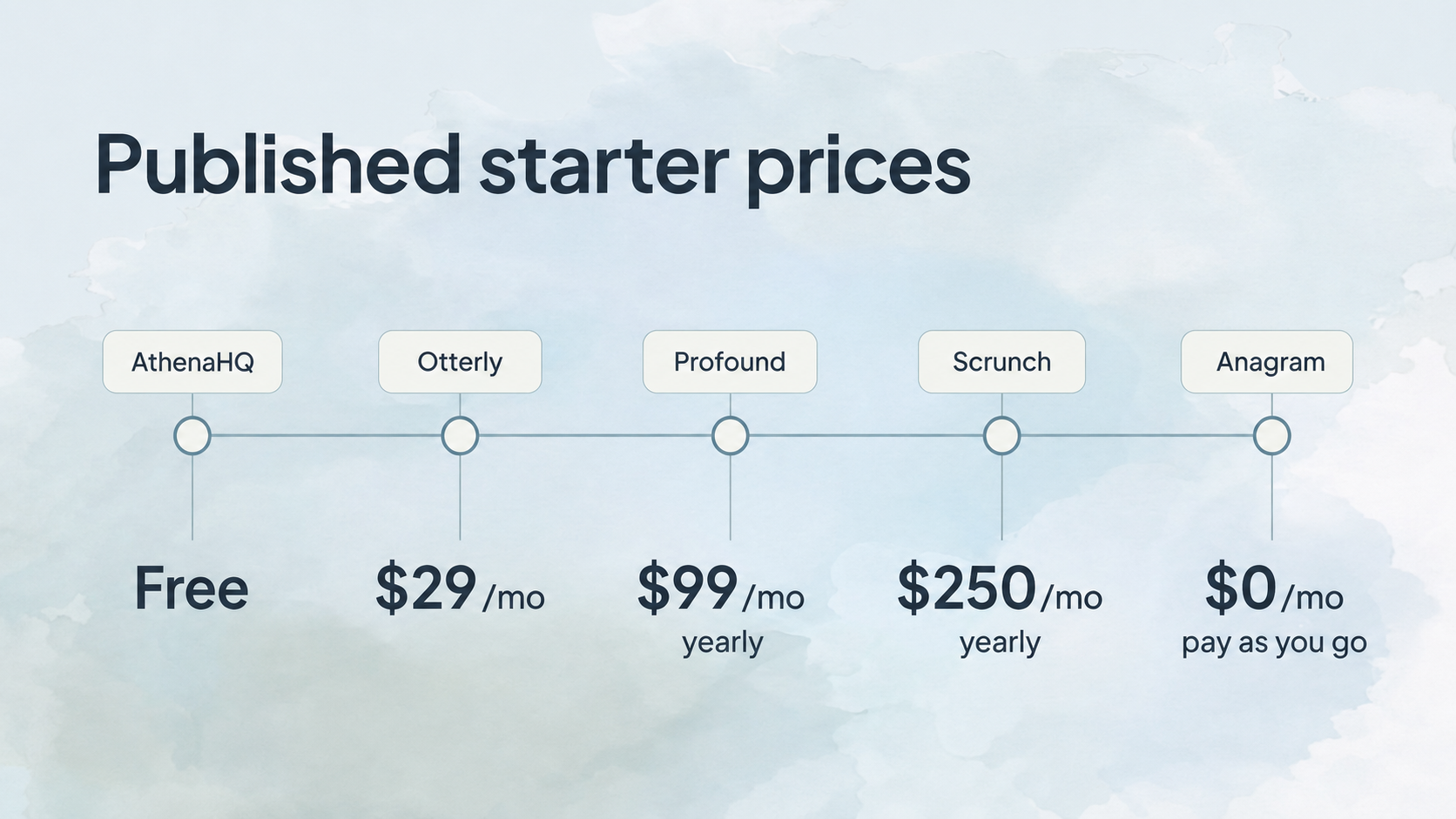
The main difference is whether the tool is built for enterprise AEO, AI search monitoring, or ecommerce action. Shopify brands should not only ask "which tool tracks ChatGPT?" They should ask whether the tool helps them improve product pages, answer shopper questions, influence sources, and connect visibility to revenue.
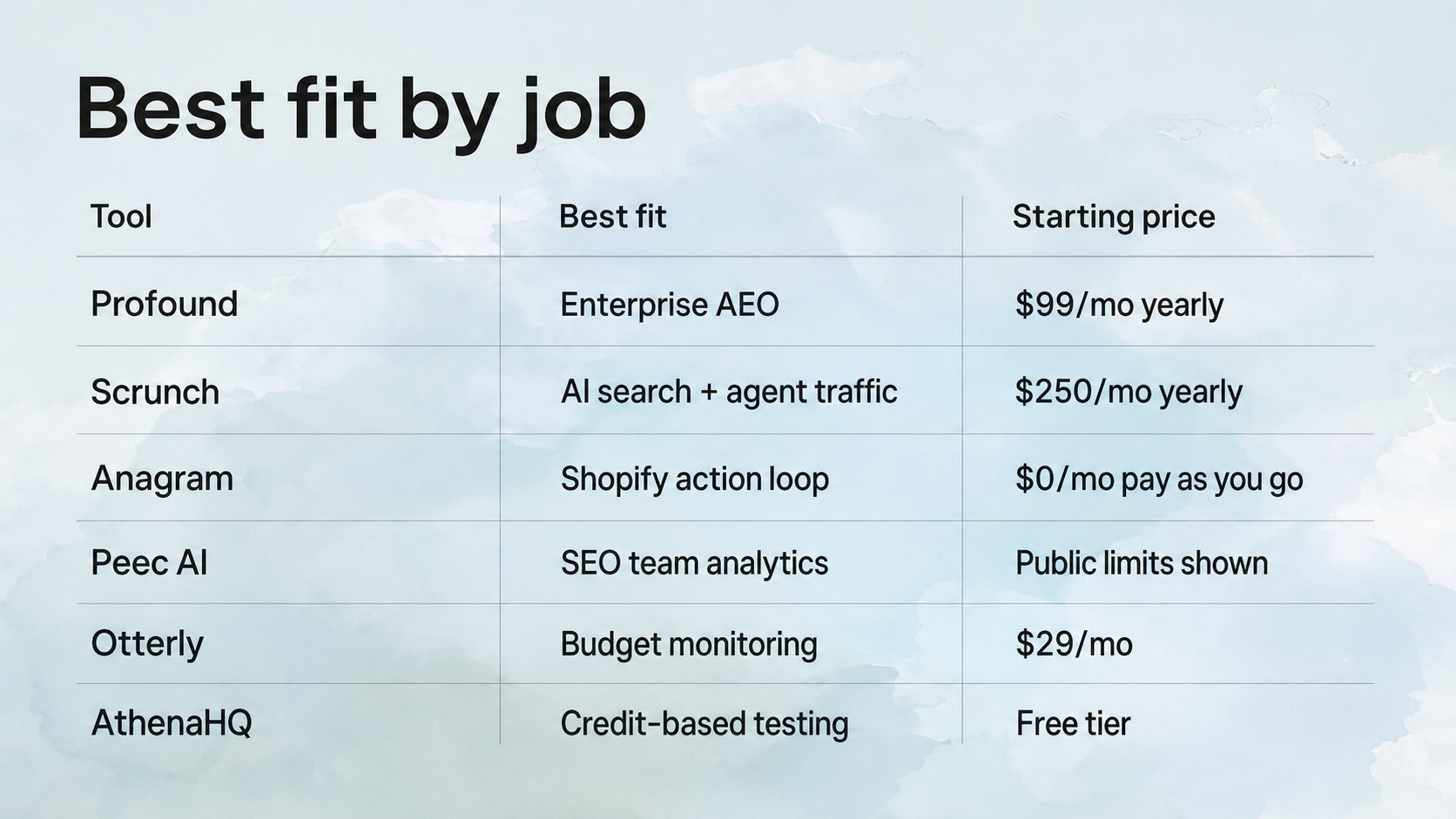
Tool | Best for | Starting price shown publicly | ChatGPT tracking | Shopify/DTC fit | Main limitation |
|---|---|---|---|---|---|
Profound | Enterprise AEO programs | $99/month billed yearly | Yes | Medium | Can be too broad for small teams |
Scrunch | AI search and agent traffic | $250/month billed yearly | Yes | Medium-high | Higher entry price |
Anagram | DTC visibility plus on-site action | $0/month pay-as-you-go for Site Agent; paid plans from $299/month | Yes | High | Less focused on broad enterprise AEO |
Peec AI | SEO/content team analytics | Public limits shown; prices not visible in crawled page | Yes | Medium | Less ecommerce-specific |
Otterly | Budget monitoring | $29/month | Yes | Medium | Fewer prompts on entry plan |
AthenaHQ | Credit-based AI search platform | Free Essential; Starter $295/month | Yes | Medium-high | Credit budgeting can be less intuitive |
Which ChatGPT visibility tool should a small Shopify team choose?
A small Shopify team should start with the tool that exposes the biggest current blind spot. Choose Otterly if the problem is basic monitoring, Anagram if the problem is connecting visibility to product-page questions and customer experience, and Scrunch or Profound if the team already has a mature AI search program.
If you have no visibility today, the cheapest useful step is to stop checking ChatGPT manually. Manual checks miss prompt variants, location differences, model changes, and source shifts. Even a lightweight monitoring tool is better than one founder asking ChatGPT the same prompt once a week.
If you already know where you are invisible but do not know what to fix, prioritize actionability. Shopify brands need to improve product data, comparison pages, FAQs, review coverage, and answerable product-page content. A dashboard that never changes the site will not move the outcome by itself.
What features matter most for Shopify ChatGPT visibility?
The most important features are prompt tracking, competitor recommendations, cited-source analysis, product-question intelligence, product-data readiness, and a workflow for improving pages. For Shopify brands, AI visibility is not only a brand-awareness metric. It affects which products shoppers discover, compare, and trust before they reach your store.
OpenAI's commerce documentation says ChatGPT commerce depends on structured catalog data and merchant inventory. AP's coverage of OpenAI's Instant Checkout launch reported that product ranking considers signals such as availability, price, quality, primary-seller status, and checkout ease. That makes product detail quality and technical readiness part of AI visibility.
Feature | Why it matters for Shopify brands |
|---|---|
Prompt tracking | Shows whether ChatGPT recommends your brand for real shopper questions |
Competitor tracking | Reveals which brands win comparison and alternative prompts |
Citation/source tracking | Shows which pages or third-party sources shape the answer |
Product-question data | Helps teams write content shoppers actually need before buying |
Product feed readiness | Helps AI systems understand price, inventory, variants, and availability |
On-site action loop | Turns visibility gaps into product-page, FAQ, and comparison fixes |
Is a ChatGPT visibility tool worth it if I already use Shopify analytics and GA4?
Yes, if ChatGPT discovery is becoming part of your customer journey. Shopify analytics and GA4 show what happens after a visitor arrives; a ChatGPT visibility tool shows whether AI assistants mention your brand before the visit, which competitors they mention instead, and which sources influence the recommendation.
The gap matters because AI traffic can be small but high-intent. Anagram reports that AI visitors are 4.4x more likely to convert than organic search visitors, and Gartner predicted traditional search-engine volume would drop 25% by 2026 as users move to AI chatbots and virtual agents.
GA4 can help you measure referrals after the click. It cannot reliably tell you how many times ChatGPT recommended your competitor, which prompt caused the answer, or which third-party article convinced the model to cite someone else. That is the job of AI visibility tooling.
How should Shopify brands choose between monitoring-only and action-oriented tools?
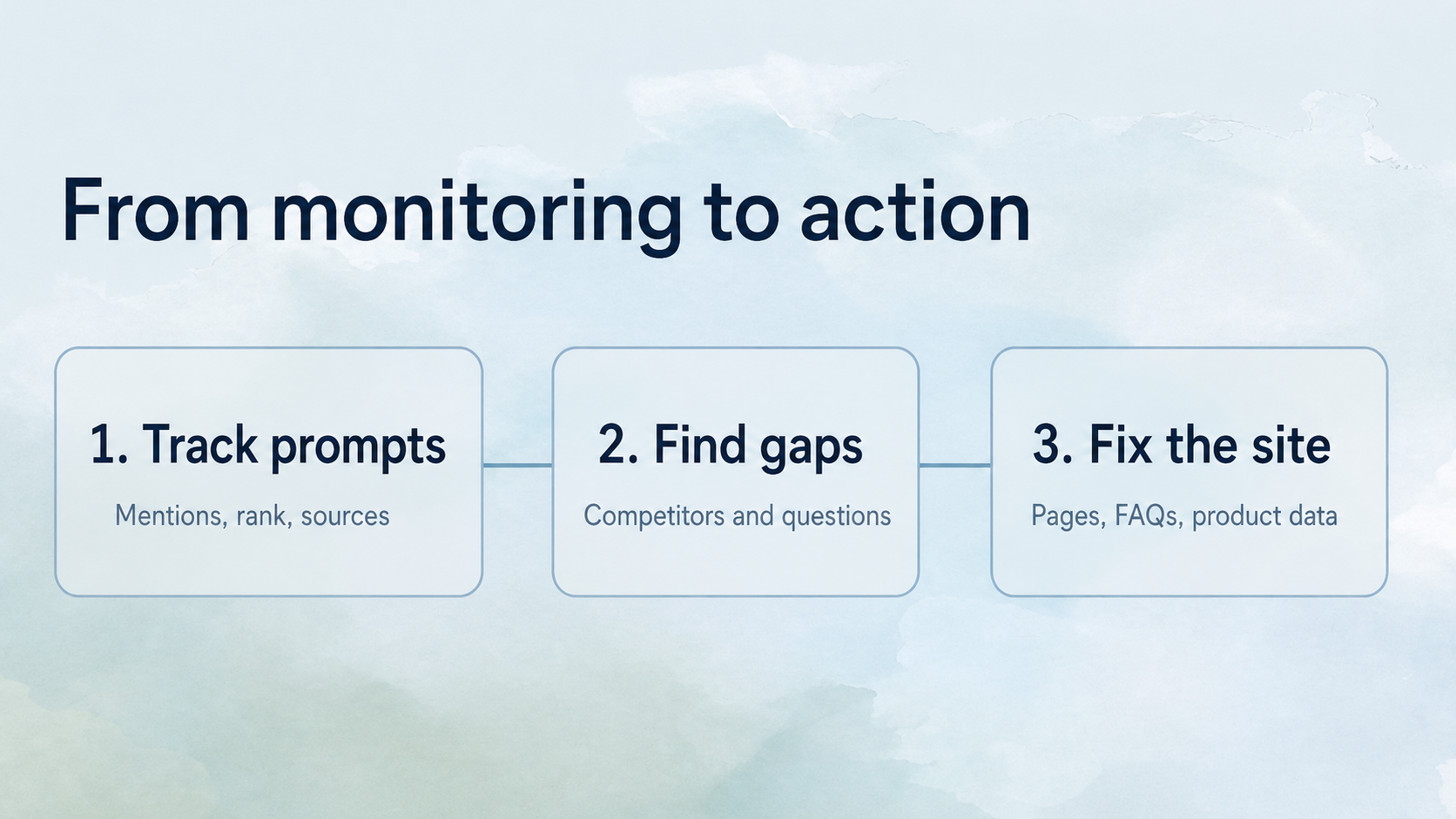
Choose monitoring-only when your first job is to measure mentions, share of voice, and cited sources. Choose an action-oriented tool when you already know the gaps and need to improve the content, product pages, FAQs, product data, and on-site experiences that influence whether ChatGPT can recommend you.
The practical rule is simple: monitoring answers "what is happening?" Action answers "what do we change next?" Early teams often need monitoring first, but DTC brands usually reach the action phase quickly because AI answers are shaped by product-specific content, reviews, availability, comparisons, and buyer questions.
Anagram's natural role is the action loop: see what shoppers ask, answer those questions on-site, learn what matters, and improve how AI understands the brand. That is different from a pure rank tracker and different from a large enterprise AEO command center.
Frequently asked questions
What is the best tool to track my brand in ChatGPT?
The best tool to track your brand in ChatGPT depends on budget and workflow. Otterly is the cheapest published starting point, Peec AI is clean for SEO teams, Scrunch and Profound fit larger AI search programs, AthenaHQ offers a free credit-based entry, and Anagram fits Shopify brands that want visibility tied to shopper questions.
What is the best ChatGPT visibility software for ecommerce?
The best ecommerce-focused ChatGPT visibility software should track prompts, competitors, sources, product questions, and the actions needed to improve product pages. For Shopify brands, Anagram is a strong fit because it connects AI visibility with on-site customer questions and branded AI experiences, while Scrunch and Profound offer broader enterprise AEO coverage.
Do Shopify brands need a separate AI visibility tool?
Shopify brands need a separate AI visibility tool once ChatGPT starts influencing discovery, comparison, or purchase decisions. Shopify analytics tells you what happens in your store; AI visibility software tells you whether ChatGPT recommends you, which competitors it favors, and what sources shape the answer before the shopper arrives.
Is ChatGPT visibility the same as SEO?
ChatGPT visibility is related to SEO, but it is not the same thing. SEO optimizes for search rankings and clicks, while ChatGPT visibility optimizes for being named, cited, or recommended inside AI-generated answers. The best Shopify strategy uses both: crawlable content, strong product data, trusted sources, and answerable pages.
Can I track ChatGPT visibility manually?
You can manually spot-check ChatGPT, but manual checks are unreliable for ongoing tracking. Answers can vary by prompt phrasing, model, location, personalization, freshness, and cited sources. A tool is useful when you need consistent prompts, competitor comparisons, historical trends, and a clear record of what changed.
Sources
Anagram, "AI Visibility" and pricing pages: https://www.anagram.ai/ai-visibility and https://www.anagram.ai/pricing
Profound pricing: https://www.tryprofound.com/pricing
Scrunch pricing and monitoring pages: https://scrunch.com/pricing and https://scrunch.com/platform/monitoring-insights/
Otterly pricing: https://otterly.ai/pricing
Peec AI pricing and homepage: https://peec.ai/pricing and https://peec.ai/
AthenaHQ homepage/pricing: https://athenahq.ai/
OpenAI, Agentic Commerce Protocol documentation: https://developers.openai.com/commerce
AP, "OpenAI's ChatGPT now lets users buy from Etsy, Shopify in push for chatbot shopping": https://apnews.com/article/3434f1b86b90b59de0baa43a8f28f380
Gartner, "Gartner Predicts Search Engine Volume Will Drop 25% by 2026": https://www.gartner.com/en/newsroom/press-releases/2024-02-19-gartner-predicts-search-engine-volume-will-drop-25-percent-by-2026-due-to-ai-chatbots-and-other-virtual-agents