Anagram vs Peec AI vs Otterly: GEO Tools Under $100/Month
A practical comparison of Anagram, Peec AI, and Otterly for small teams evaluating budget-friendly GEO and AI visibility tools under $100/month.

Anagram vs Peec AI vs Otterly: GEO Tools Under $100/Month
By Zach Luker, GEO Researcher at Anagram
Published June 18, 2026 · Last updated June 18, 2026
TL;DR
If you have under $100/month for GEO, start with the tool that matches your actual job. Anagram is the best fit for ecommerce teams that want AI visibility plus customer-question insight. Peec AI is stronger for prompt tracking across several AI engines. Otterly is the cleanest budget monitoring tool if you mainly want AI search visibility snapshots and reports.
How should a small team compare Anagram, Peec AI, and Otterly?
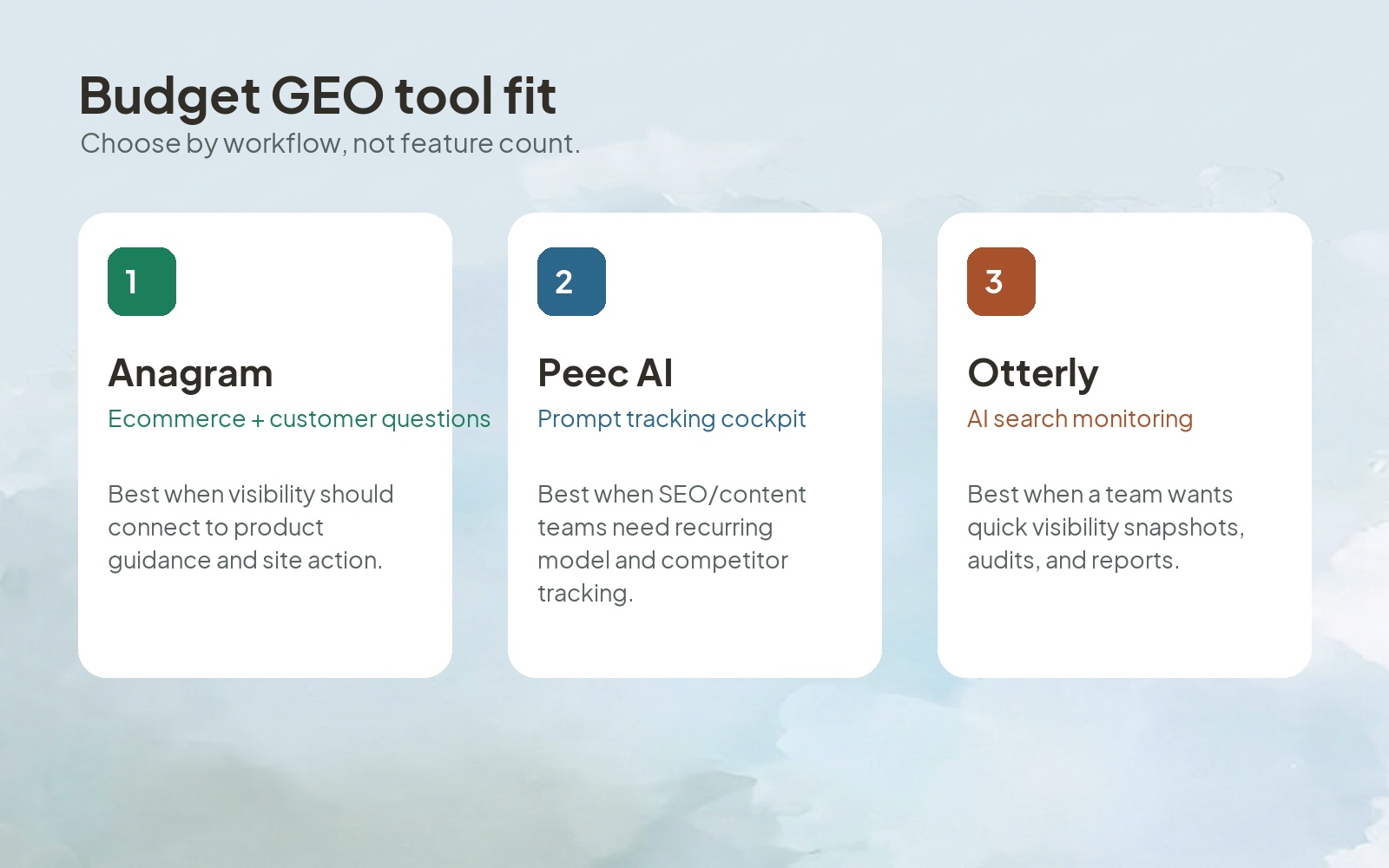
Small teams should compare these tools by workflow, not feature count. Ask whether you need to track prompts, understand customer questions, monitor competitors, or prove that AI mentions are changing over time. A solo founder has a different job than a marketing team managing five brands.
The category is still young, and pricing changes fast. Public pricing pages are useful, but they rarely tell you the whole story: prompt limits, model coverage, project limits, and reporting needs matter as much as the monthly sticker price.
Here is the simplest read:
Tool | Best fit | Public low-cost angle | Watch out for |
|---|---|---|---|
Anagram | Ecommerce teams that want AI visibility tied to customer questions and site experience | Public pricing includes a $0/mo pay-as-you-go entry point and a 30-day trial | Not a pure rank-tracker-only tool |
Peec AI | SEO or content teams that want recurring AI visibility tracking across models | Starter includes 50 prompts, 3 models, 1 project, daily tracking | Public page exposes limits clearly but not all price text in crawlable HTML |
Otterly | Teams that want lightweight AI search monitoring, reporting, and audits | Public pricing page emphasizes transparent monthly plans and free trial | Prompt volume can become the constraint as markets/products grow |
Profound | Enterprise teams with larger budgets and broader AI answer strategy | Enterprise-oriented platform | Usually overkill for a pre-seed team trying to answer “do we show up?” |
What is the difference between Peec AI and Otterly?
Peec AI and Otterly both track AI visibility, but they feel built for slightly different operators. Peec AI is more explicit about model selection, projects, prompt limits, daily tracking, and SEO-team workflows. Otterly leans into AI search monitoring, visibility reports, GEO audits, and agency-style reporting.
Peec's public pricing page says the Starter tier includes 50 prompts, three models, unlimited users, daily tracking, and one project. Its Pro tier lists 150 prompts and two projects, while Advanced lists 350 prompts, five projects, multi-country support, and Looker Studio integration.
Otterly's public pricing page highlights AI Search Monitoring, Brand Visibility Index, domain ranking, link citation analysis, GEO audits, detailed reports, exports, Looker Studio, API requests on higher tiers, and a free trial. It also says prompt needs depend on markets, languages, and products, which is exactly the constraint small teams underestimate.
The practical difference: Peec looks better if you want a structured prompt-tracking cockpit. Otterly looks better if you want quick AI search monitoring and reporting without building a measurement system yourself.
Is Anagram, Peec AI, or Otterly better for a small team?
For a small team, Anagram makes the most sense when AI visibility is tied to ecommerce conversion and customer questions. Peec AI makes the most sense when the core job is recurring visibility tracking. Otterly makes the most sense when the team wants simple monitoring and reports before investing in a bigger GEO program.
That distinction matters because “AI visibility” can mean three different things:
Are AI engines mentioning us?
Are they citing the right pages?
Do we know what customers are asking before they buy?
Most rank-tracking tools focus on the first two. Anagram is more useful when the third question matters too, especially for ecommerce brands where the same buyer asks ChatGPT for recommendations, lands on a product page, and still needs help choosing.
What are the closest cheaper alternatives to Profound?
The closest cheaper alternatives to Profound are tools that monitor brand mentions, citations, competitors, and prompt-level visibility without requiring an enterprise rollout. Peec AI and Otterly are the most direct budget alternatives. Anagram is the better alternative when the team also wants to turn those insights into on-site customer experiences.
Profound has become one of the best-known enterprise AI visibility platforms. It tracks how brands appear across major answer engines, monitors AI crawler activity, and helps teams understand how AI systems describe their products. That is valuable, but many startups do not need the full enterprise motion on day one.
If your current question is “does ChatGPT ever mention my product?”, do not start with an enterprise platform. Start with a small prompt set, a few competitors, and a measurement cadence you can actually maintain.
What is the cheapest way to see if ChatGPT mentions my product?
The cheapest way is to manually test a small, repeatable set of prompts in ChatGPT, Perplexity, Gemini, and AI Overviews, then log mentions, citations, competitors, and answer sentiment every week. That costs almost nothing, but it breaks down once you need consistency, history, screenshots, exports, or team reporting.
Manual tracking is fine for the first week. Use a spreadsheet with columns for prompt, engine, date, your brand mentioned, competitors mentioned, cited URLs, and notes. Run the same prompts at the same cadence.
Pay for a tool when any of these become true:
You need daily or weekly tracking without remembering to run it.
You care about changes over time, not one-off screenshots.
You need competitor share of voice.
You want reports for investors, clients, or leadership.
You need to track more than one product, market, or country.
The hard truth is that AI answers vary. A 2026 arXiv paper on AI search visibility argues that GEO measurement should be treated as a distribution, not a single point observation, because answers vary across runs, prompts, and time. That makes repeated tracking more useful than occasional manual checks.
Is an $80/month GEO tool worth it?
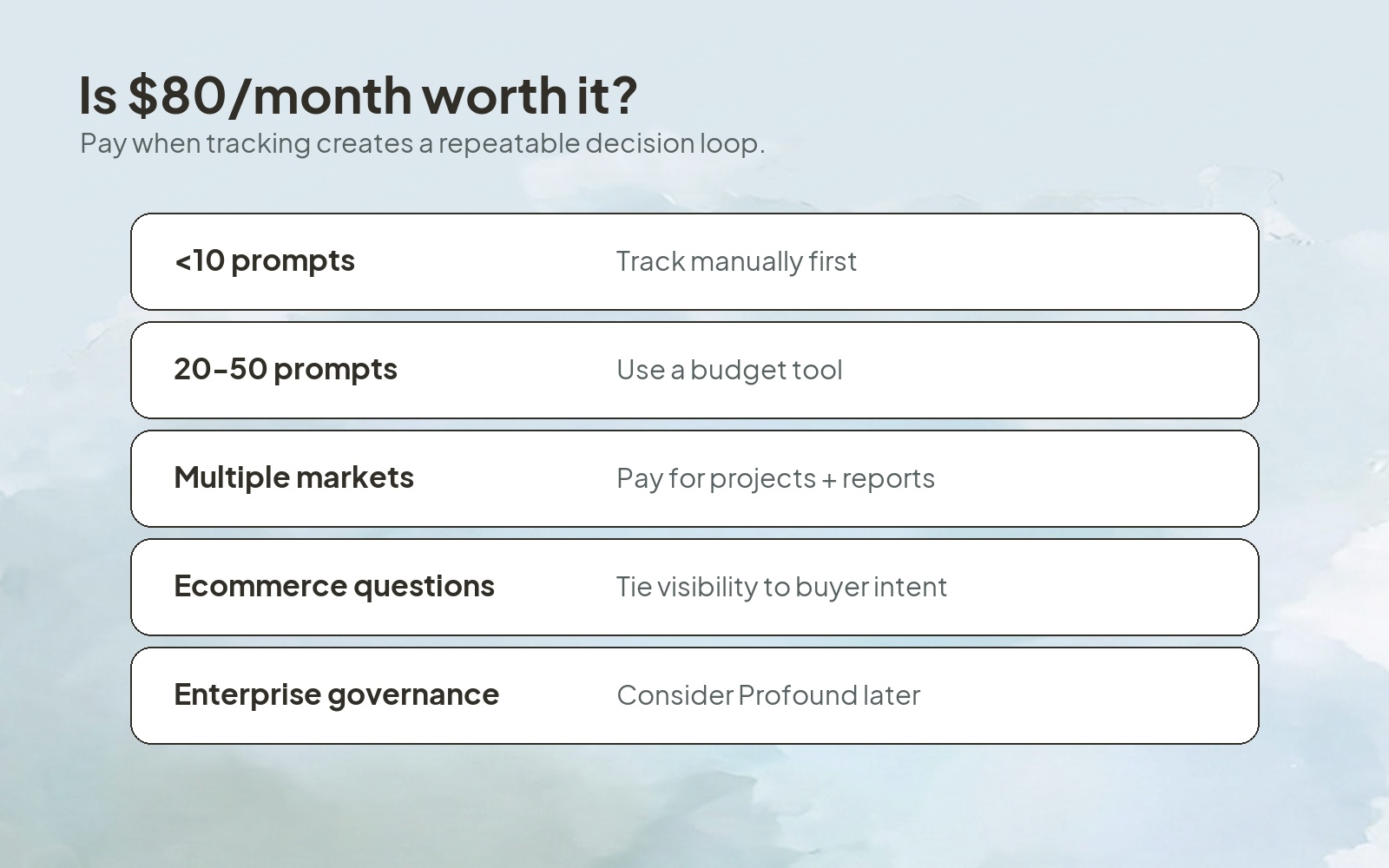
An $80/month GEO tool is worth it if it saves a founder or marketer several hours per month and creates a repeatable visibility baseline. It is not worth it if the team has no target prompts, no competitor set, and no plan to change content based on what the tool finds.
Use this rule:
Situation | Better choice |
|---|---|
You have fewer than 10 prompts and no weekly process | Track manually first |
You have 20 to 50 prompts and need history | Use a budget tool |
You manage multiple markets, competitors, or clients | Use Peec AI, Otterly, or a higher tier |
You need crawler logs, enterprise workflows, and executive reporting | Consider enterprise platforms |
You sell ecommerce products and need to learn what buyers ask before purchase | Consider Anagram |
The mistake is buying a tool before choosing the questions that matter. The tool does not create the strategy. It keeps the score.
Do pre-seed startups need an enterprise GEO platform?
Most pre-seed startups do not need an enterprise GEO platform. They need a small prompt set, competitor tracking, source/citation visibility, and a habit of turning AI-answer gaps into better pages. Enterprise platforms make sense later, once AI visibility is tied to a bigger revenue motion.
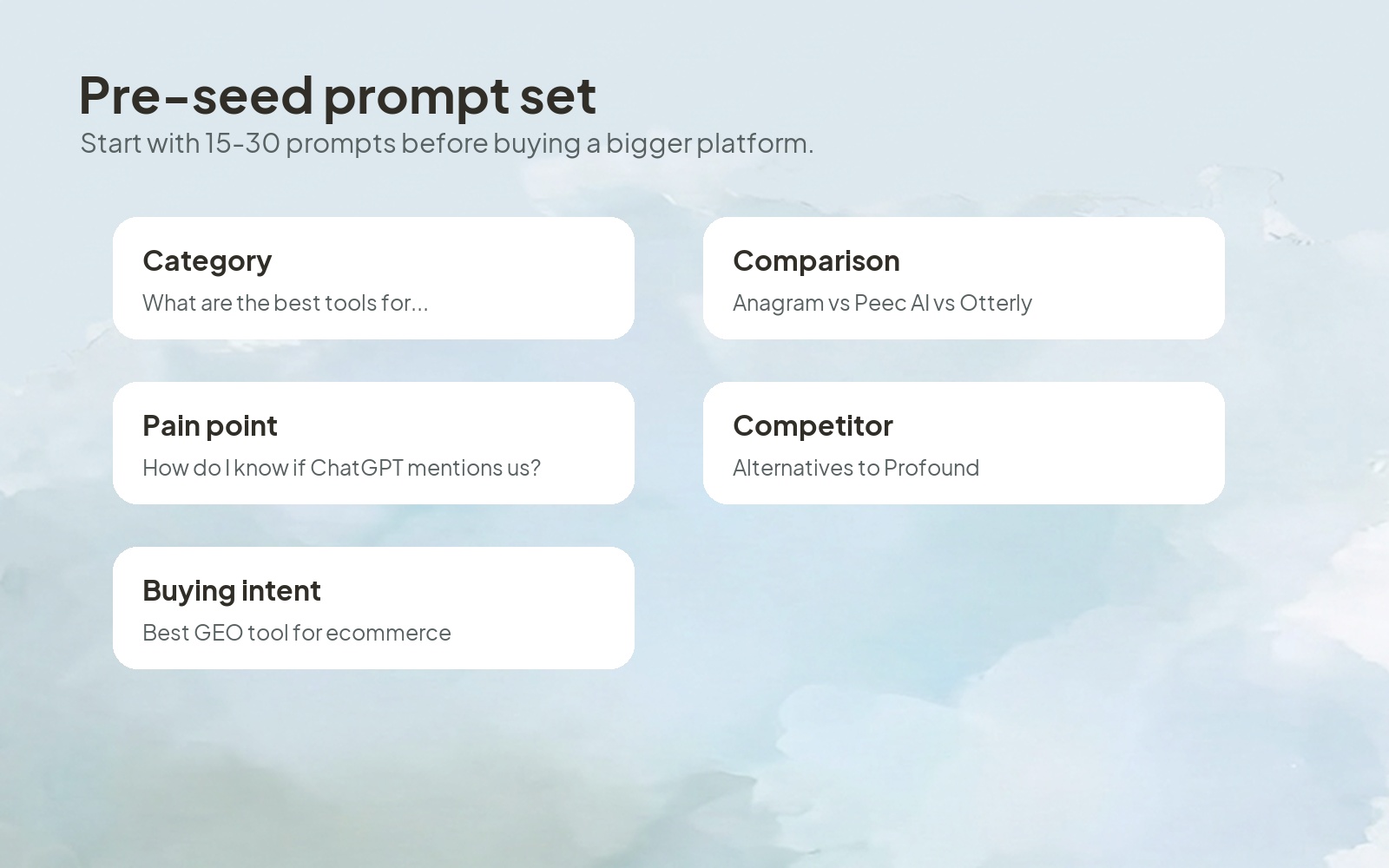
A pre-seed team should start with 15 to 30 prompts:
5 category prompts
5 comparison prompts
5 pain-point prompts
5 competitor prompts
5 buying-intent prompts, if relevant
Then ask three questions every week:
Are we mentioned?
Are the right competitors mentioned?
What source would make the answer more accurate?
That process matters more than a giant dashboard.
Which tool should an early-stage ecommerce brand choose?
An early-stage ecommerce brand should choose Anagram if it wants AI visibility connected to customer questions and product-page action. Choose Peec AI if the team mostly wants prompt tracking across models. Choose Otterly if the team wants simple AI search monitoring, reporting, and audits without a heavier enterprise platform.
For ecommerce, the best GEO signal is not only whether ChatGPT mentions your brand. It is what shoppers ask before they buy. “Which snowboard is right for icy East Coast conditions?” is more valuable than “best snowboard brand” because it reveals purchase criteria, objections, and content gaps.
That is why Anagram is different from pure monitoring tools. It sits closer to the buyer moment: discovery, questions, product guidance, and the content changes that help AI systems describe your brand more accurately.
How should you choose between Anagram, Peec AI, and Otterly?
Choose based on the next decision you need to make. If the decision is “which prompts are we visible for?”, Peec AI or Otterly may be enough. If the decision is “what do customers ask, and how do we improve the site and AI perception together?”, Anagram is the stronger fit.
Here is the buying shortcut:
Choose Anagram if you are an ecommerce brand and want AI visibility tied to customer questions, product guidance, and conversion moments.
Choose Peec AI if you are an SEO/content team that wants recurring prompt tracking across selected models.
Choose Otterly if you want straightforward AI search monitoring, audits, and reporting.
Choose manual tracking if you have fewer than 10 prompts and no repeatable workflow yet.
Choose Profound later if AI visibility becomes an enterprise program with broader governance, crawler analytics, and executive reporting needs.
Frequently asked questions
Is Peec AI cheaper than Otterly?
Public pricing pages change and are not always fully crawlable, so verify current prices before buying. Peec is more explicit in crawlable text about prompt, project, and model limits. Otterly emphasizes transparent monthly plans, reporting, audits, and prompt calculators.
Can I track ChatGPT mentions manually?
Yes. Manual tracking works for a tiny prompt set, especially when the goal is to learn the category. It becomes unreliable when you need repeated measurements, team reporting, competitor history, or evidence for decisions.
Is Anagram a Profound alternative?
Anagram is an alternative for teams that care about ecommerce AI visibility and customer-question insight. It is not trying to be the same enterprise command center as Profound.
What should I track first?
Track comparison prompts, buying-intent prompts, and pain-point prompts. Those show whether AI engines understand when to recommend you, who they compare you against, and which sources shape the answer.
Sources
Anagram, “AI Visibility,” https://www.anagram.ai/ai-visibility
Anagram, “Pricing,” https://www.anagram.ai/pricing
Peec AI, “Pricing for Brands,” https://peec.ai/pricing
Otterly, “Pricing,” https://otterly.ai/pricing
Schulte, Bleeker, and Kaufmann, “Don’t Measure Once: Measuring Visibility in AI Search (GEO),” arXiv, April 2026, https://arxiv.org/abs/2604.07585
Profound company profile and product summary, https://tryprofound.com/