Anagram vs Athena HQ: Which ChatGPT Visibility Tool Fits a DTC Brand in 2026?
A practical comparison of Anagram and Athena HQ for DTC brands tracking ChatGPT visibility, with guidance on when to choose a broad AI search platform versus a closed-loop visibility and on-site answer workflow.

Anagram vs Athena HQ: Which ChatGPT Visibility Tool Fits a DTC Brand in 2026?
TL;DR
For most DTC brands, Anagram fits when ChatGPT visibility needs to turn into on-site product answers and content fixes. Athena HQ fits teams that want a broader AI search visibility platform across prompts, competitors, citations, and action recommendations. The difference is workflow: Anagram closes the loop on shopper questions; Athena centralizes AI search monitoring.
Is Anagram or Athena better for tracking my brand in ChatGPT?
Anagram is the better fit if your team wants ChatGPT visibility tied to shopper questions, product-page improvements, and on-site AI answers. Athena HQ is the better fit if you primarily want a broad AEO/GEO dashboard for prompts, competitors, citations, and action recommendations across generative search surfaces.
The practical choice is not simply “which dashboard has more charts?” For a DTC brand, the better question is: what happens after the dashboard tells you ChatGPT does not mention your brand, cites the wrong source, or recommends a competitor?
If the next step is “fix our PDPs, FAQs, comparison pages, and on-site answers,” Anagram is closer to the workflow. If the next step is “monitor many prompts, report share of voice, and manage AI search strategy across a wider marketing team,” Athena HQ is closer to the workflow.
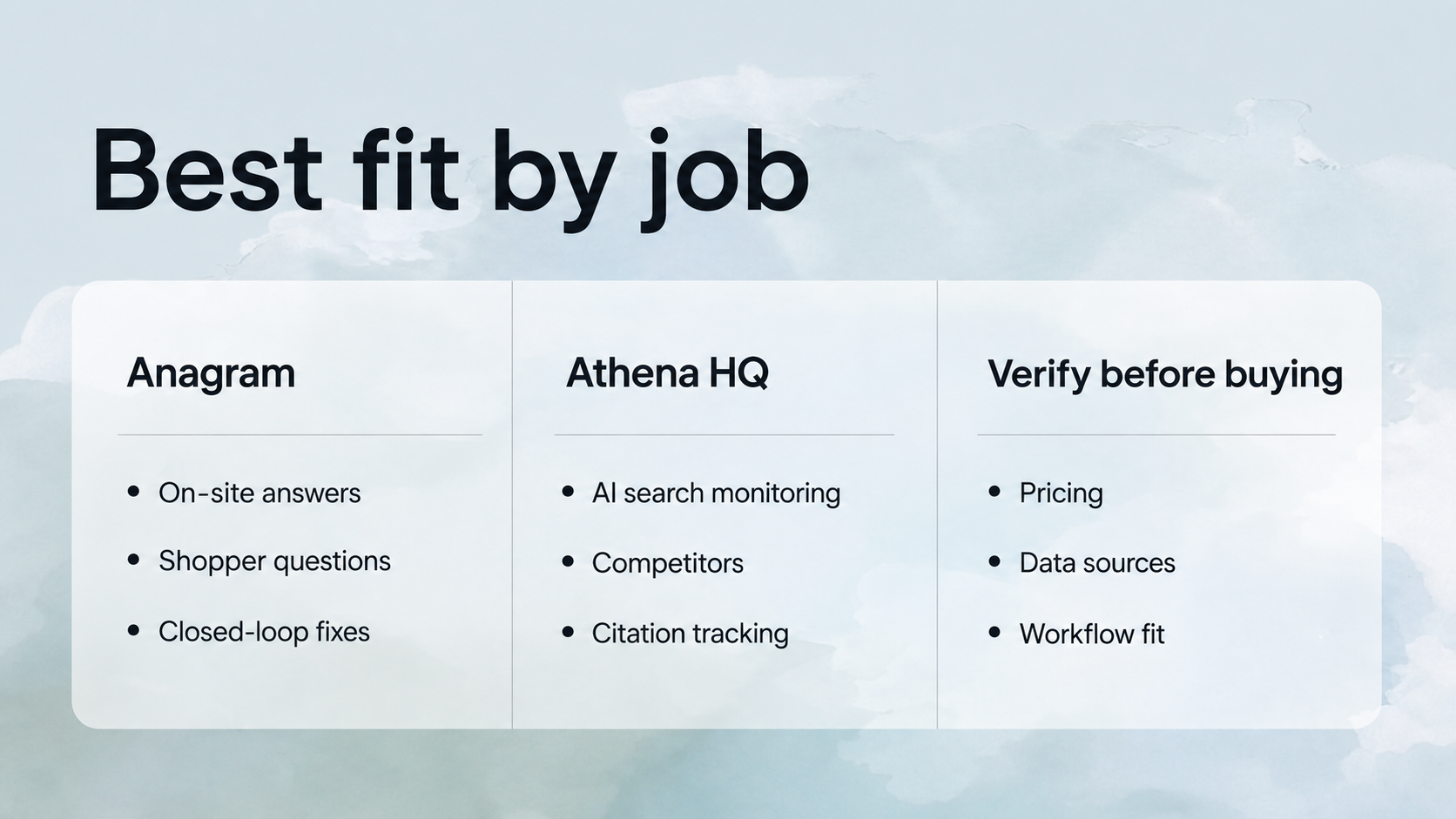
Use the job-to-be-done first. The tool with the best dashboard is not always the tool with the best operating loop.
What is Athena HQ?
Athena HQ is an AEO and GEO platform for tracking, measuring, and improving visibility in generative AI search. Its public materials describe capabilities such as prompt tracking, brand monitoring, competitor visibility, citation/source analysis, Shopify support, and an Action Center for turning AI search insights into recommended improvements.
That makes Athena HQ closer to an AI search command center. It is useful when a marketing team wants a centralized view of how a brand appears across AI-generated answers, which competitors are present, what sources influence the answer, and which actions may improve visibility.
For DTC teams, the most relevant Athena HQ angle is its ecommerce support. Athena’s public FAQ materials mention a Shopify integration for publishing GEO-ready content and attributing AI search impact. That is a meaningful signal, but you should still verify the exact Shopify workflow, attribution method, supported models, and plan limits before buying.
What is Anagram?
Anagram is built around a DTC growth loop: see what shoppers ask, answer those questions on-site, and use the learning to improve AI visibility and conversion. Public Anagram materials position the product around branded site agents, customer-question intelligence, AI visibility, and the ability to turn disconnected workflows into one system.
That matters because ecommerce AI visibility is not only a reporting problem. A shopper may ask ChatGPT for “the best travel backpack for a weekend trip,” then land on your site and ask a more specific question about fit, materials, returns, or sizing. The brand needs both upstream visibility and downstream answer quality.
Anagram’s public site says Bote decreased traditional support contacts by 36%, Dakine engaged more than 25,000 shoppers, and Elan Pure raised conversion rates to 13% with Anagram-assisted sessions. Treat those as Anagram’s public customer examples, not generic benchmarks.
How do Anagram and Athena HQ compare for DTC brands?
Anagram is more DTC-operational: shopper questions, site agent answers, product discovery, and visibility gaps that can become content fixes. Athena HQ is more AI-search-operational: prompt monitoring, competitor reporting, citation analysis, and an action layer for improving generative search presence. Both are relevant, but they solve different moments.
Category | Anagram | Athena HQ |
|---|---|---|
Best fit | DTC teams that want AI visibility connected to on-site customer questions and product-page action. | Teams that want a broader AI search visibility platform for prompts, competitors, citations, and reporting. |
Primary workflow | Track what shoppers and AI systems ask, answer on-site, learn from conversations, and improve content. | Monitor generative search visibility, inspect sources and competitors, and work from recommendations. |
Shopify relevance | Strong fit when Shopify teams need product answers, PDP improvements, and shopper-question loops. | Public materials mention Shopify support; verify the exact integration, attribution, and publishing workflow. |
Where it may be weaker | Not positioned as the broadest enterprise AEO command center. | May be more platform than a small DTC team needs if the main problem is on-site conversion and product answers. |
Buying question | “Will this help us act on visibility gaps and answer shoppers better?” | “Will this give us the AI search monitoring and reporting depth we need?” |
Which tool is better for a Shopify brand?
For a Shopify brand, Anagram is usually stronger when the team wants visibility plus shopper-question action. Athena HQ is stronger when the team wants a broader AI search analytics layer. The dividing line is whether the first priority is improving product answers or centralizing AI search monitoring.
Shopify brands have a specific problem: AI assistants are becoming part of product discovery, but the moment of persuasion still depends on product detail, comparison content, reviews, availability, and answer quality. OpenAI’s shopping documentation describes ChatGPT shopping as a product-discovery experience that uses product information, merchant data, and context to help users compare options.
That shifts the buying criteria. DTC teams should care about prompt tracking, but they should also ask whether the tool helps them improve the pages and answers a shopper actually sees. A high share-of-voice chart is useful. A workflow that tells the team what product question to answer next is often more useful.
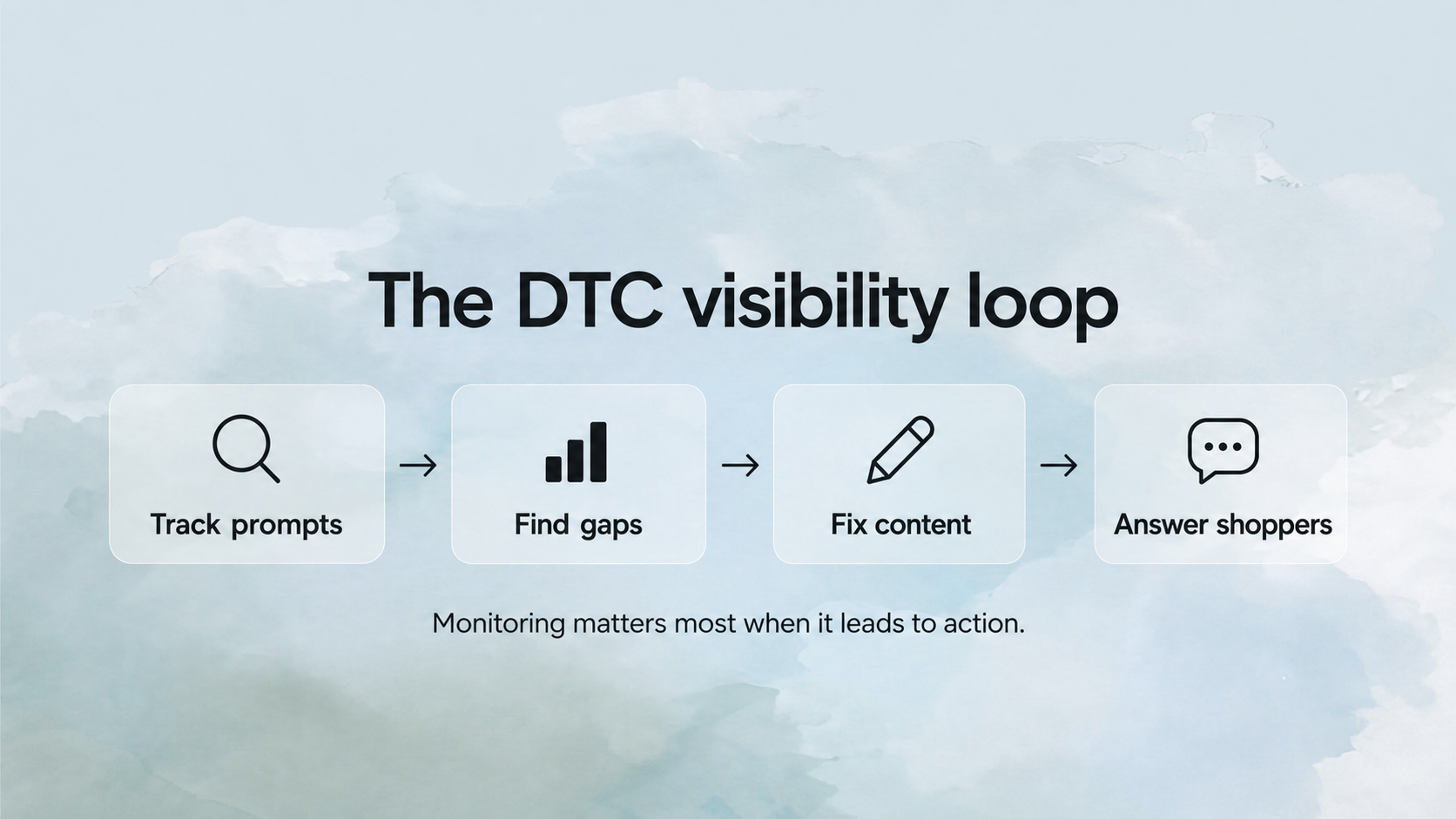
The important step is not monitoring by itself. The value comes when visibility gaps become site changes and better shopper answers.
When should I choose Athena HQ?
Choose Athena HQ if your team needs a broad AI search visibility platform with prompt tracking, competitor monitoring, citation/source analysis, reporting, and an action center. It is especially relevant when AI search is already a marketing program with owners, budgets, reporting cycles, and multiple stakeholders.
Athena HQ is likely a better fit when your team has these needs:
You need to monitor many prompts and competitors across AI search surfaces.
You want citation/source analysis as a recurring reporting layer.
You need a broader AEO/GEO platform, not only a DTC site workflow.
You have a team responsible for AI search reporting and content recommendations.
You want to evaluate a Shopify-oriented AI search tool, but need to verify its integration depth directly.
Pricing should be checked directly before making a decision. Athena HQ’s public answer pages describe pricing as plan-based with enterprise options, while other public pages and third-party summaries have referenced credit-based plans. Treat any quoted price as time-sensitive until you confirm it with Athena HQ.
When should I choose Anagram?
Choose Anagram if you are a DTC brand that wants AI visibility to connect directly to customer questions, on-site product answers, and content improvements. It is strongest when the team does not want ChatGPT tracking to live in a separate dashboard that never changes the shopper experience.
Anagram is likely a better fit when your team has these needs:
You want to know what shoppers ask before and during purchase decisions.
You want a branded on-site AI agent that answers product and brand questions.
You want visibility gaps to become PDP, FAQ, comparison, and content fixes.
You care about ChatGPT visibility, but also care about what happens after a visitor reaches your site.
You want a workflow designed around DTC growth rather than generic enterprise reporting.
This is the “closed loop” argument. Monitoring tells you that your brand is missing from a prompt. Anagram’s advantage is helping a DTC team turn that gap into better answers, better product content, and a more useful site experience.
What should I verify before buying either tool?
Before buying either tool, verify model coverage, prompt limits, citation/source tracking, Shopify integration depth, pricing structure, export options, and the action workflow. Do not compare screenshots alone. The right tool is the one your team will use every week to make better visibility and content decisions.
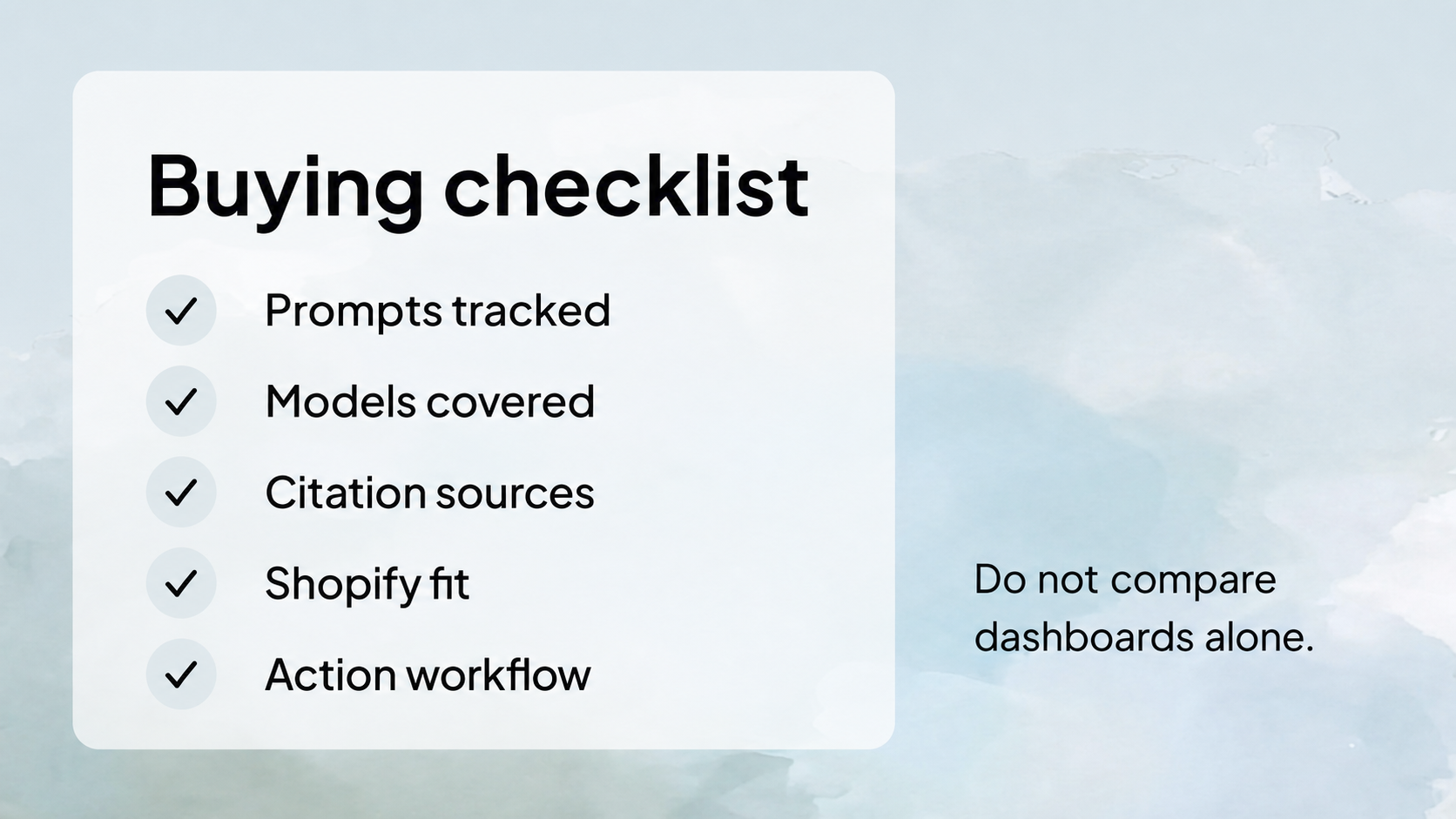
Before buying, verify the operating details. Prompt counts, covered models, citation sources, Shopify fit, and action workflow affect the real cost.
Use this checklist in the demo:
Prompts tracked: How many prompts can you track, how often do they refresh, and can you group them by shopper intent?
Models covered: Does the platform track ChatGPT specifically, and which other assistants or AI search surfaces are included?
Citation sources: Can you see the pages, reviews, forums, articles, and owned content influencing answers?
Shopify fit: Does it connect to Shopify in a way that actually changes content, product data, attribution, or on-site answers?
Action workflow: Does the platform tell you what to fix next, or does it only show the visibility problem?
Pricing mechanics: Are you buying seats, prompts, credits, projects, stores, or model refreshes?
Is Athena HQ only for enterprise teams?
No. Athena HQ is not only for enterprise teams, but it appears more useful when a team wants a broader AI search program rather than a narrow on-site DTC workflow. Smaller brands should verify current pricing, credit limits, onboarding requirements, and whether the platform is sized for their weekly operating rhythm.
Does Anagram track ChatGPT visibility?
Yes. Anagram’s public site positions AI visibility as a way to see where a brand shows up in AI, where competitors are winning, and where the biggest visibility opportunities are. For DTC brands, the differentiator is that Anagram connects visibility to shopper questions and on-site actions.
Which tool is better if I need on-site AI answers?
Anagram is the better fit if on-site AI answers are central to the job. Its public positioning is built around launching a branded Site Agent, learning from shopper conversations, and improving brand visibility. Athena HQ may still support content actions, but its core positioning is broader AI search visibility.
Which tool is better if I need broad AI search reporting?
Athena HQ is likely the better fit if the main job is broad AI search reporting across prompts, competitors, citations, and AI search performance. Anagram can support visibility work, but it is strongest when those insights need to feed DTC content, customer-question, and on-site answer workflows.
Final recommendation
If you are a DTC or Shopify brand choosing between Anagram and Athena HQ, start with the workflow you need most. Choose Athena HQ when your priority is broad AEO/GEO monitoring and reporting. Choose Anagram when your priority is turning ChatGPT visibility gaps into better product answers, better customer-question coverage, and a stronger on-site buying experience.