Using an AI Visibility Tool vs Manually Checking Prompts in ChatGPT in 2026
Manual ChatGPT checks are useful for spot checks, but they are weak as measurement. This guide explains when to use manual checks, when to use an AI visibility tool, and how to combine both into a repeatable GEO workflow.

TL;DR
Manual ChatGPT checks are useful for quick spot checks, but they are not enough to measure AI visibility. Use manual checks to inspect answer quality and positioning. Use an AI visibility tool when you need repeatable prompt tracking, competitor comparisons, citation monitoring, trend history, and a workflow for turning findings into content fixes.
Should I just check ChatGPT myself or use a tool?
You can check ChatGPT manually when you only need a quick directional read. Use a tool when the question changes from “did ChatGPT mention us once?” to “how often are we mentioned, where are we cited, which competitors show up, and what changed over time?”
Manual checking is attractive because it is free and immediate. A founder can open ChatGPT, type a few commercial prompts, and see whether the brand appears.
That is a good first step. It is not a measurement system.
ChatGPT search can choose when to search the web, rewrite prompts into targeted search queries, and show citations or sources when search is used, according to OpenAI’s search documentation. Those behaviors make AI visibility a moving target: the answer can vary by prompt phrasing, timing, location, model behavior, and source availability.
What does manual ChatGPT checking do well?
Manual checking is best for qualitative inspection. It helps you see the exact answer a shopper might read, the wording around your brand, the competitors ChatGPT frames you against, and whether the answer feels fair, outdated, incomplete, or wrong.
Manual checks are especially useful for:
Testing a new target prompt before adding it to a tracking system.
Reading the full answer, not only counting whether your brand appeared.
Checking whether ChatGPT describes your product accurately.
Finding obvious content gaps in one answer.
Capturing examples for internal discussion.
Manual checking also helps teams avoid a dashboard-only mindset. If a tool says visibility improved but the actual answer is low-quality, misleading, or buried below better competitors, the brand still has work to do.
Where does manual checking break down?
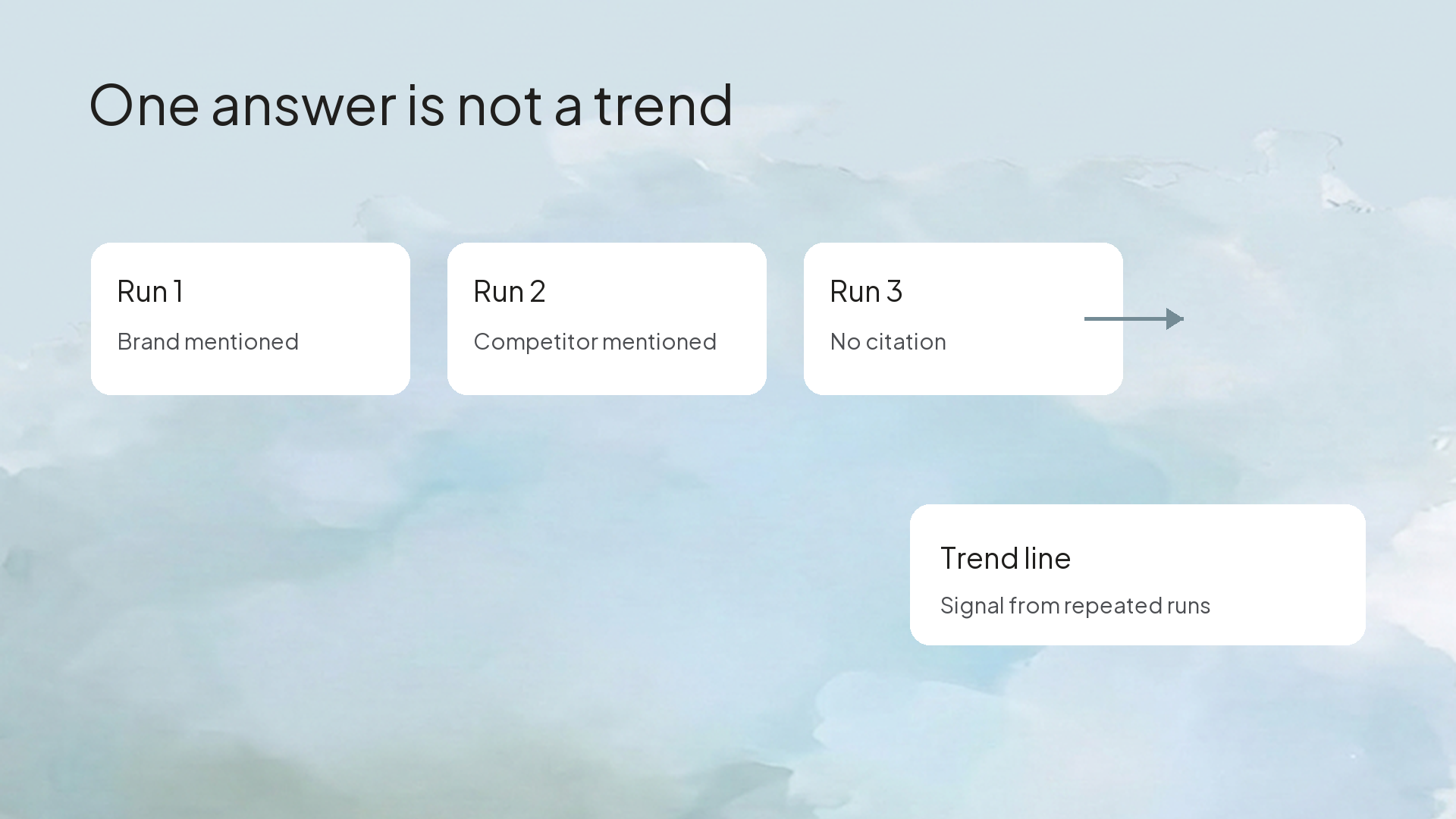
Manual checking breaks down when teams treat one answer as the truth. Generative search answers are variable, and a single run can miss prompt variants, competitor movement, citations, geography, timing, and changes in source selection.
The failure mode is false precision. A team asks ChatGPT five prompts on Monday, sees two brand mentions, and decides its visibility is 40%. That number is not reliable because the sample is too small and usually not repeated under consistent conditions.
Research on generative search measurement argues that citation visibility should be treated as a sample from a response distribution, not as a fixed value. A 2026 arXiv paper on AI visibility uncertainty found substantial variability across repeated samples in Perplexity, OpenAI SearchGPT, and Google Gemini.
That matters for operators. If two brands appear close in a handful of manual checks, the apparent difference may be noise.
Do I need a tool to track my ChatGPT visibility?
You need a tool if AI visibility is becoming a recurring marketing, content, or ecommerce workflow. A tool is most valuable when you care about trend lines, prompt sets, source URLs, competitor share, answer changes, and prioritizing which pages to fix next.
The real difference is repeatability.
An AI visibility tool should run the same prompts on a schedule, store the results, identify whether your brand was mentioned, track competitors, record cited URLs, and show how visibility changes after you publish or update content.
Manual checks can tell you what happened in one moment. A tool can tell you whether the pattern is improving.
What should an AI visibility tool measure?
An AI visibility tool should measure brand presence, competitor presence, citations, answer position, sentiment or framing, prompt-level trends, and source quality. The goal is not just to produce a score. The goal is to show which prompts and pages deserve action.
At minimum, track these dimensions:
Dimension | Manual checking | AI visibility tool |
|---|---|---|
Prompt coverage | A few prompts at a time | Dozens or hundreds of prompts |
Repeatability | Inconsistent unless documented | Scheduled and standardized |
Competitor tracking | Manual notes | Side-by-side share of answers |
Citation URLs | Easy to miss or forget | Stored and trended |
History | Screenshots or docs | Time series and change logs |
Action workflow | Requires manual interpretation | Prioritized gaps and fixes |
The best tools go beyond monitoring. They connect measurement to next actions: which pages need clearer answers, which product pages need better structure, which comparison pages are missing, and which prompts deserve new content.
What is the difference between AI visibility monitoring and manual prompt checking?
Manual prompt checking is an inspection method. AI visibility monitoring is a measurement system. Manual checks show what one answer looked like when one person asked one prompt. Monitoring shows how a brand performs across prompts, competitors, sources, and time.
That distinction matters because AI search is not a static ranking page.
OpenAI says ChatGPT search may rewrite the user’s prompt into one or more targeted queries and may use source links or a sources panel when citations are available. That means prompt wording and source retrieval can shape the answer a user sees.
For a DTC brand, the practical implication is simple: track prompt clusters, not only exact prompts.
Examples:
“Best electrolyte powder for runners”
“What electrolyte powder should I buy for marathon training?”
“LMNT vs Liquid I.V. for long runs”
“Best low-sugar electrolyte drink”
“What hydration brand does ChatGPT recommend?”
Those prompts are related, but they may surface different brands and sources.
How should a small team decide between manual checks and a paid tool?
A small team should start manually if it has fewer than 10 target prompts, no repeatable publishing workflow, and no one assigned to act on the findings. Move to a tool when prompt tracking becomes recurring work or when visibility affects content, positioning, or acquisition decisions.
Use this decision rule:
Situation | Better choice |
|---|---|
You are validating whether AI visibility matters | Manual checks |
You only care about 5-10 prompts | Manual checks |
You publish content monthly or more | Tool |
Competitors appear more often than you | Tool |
You need reporting for leadership or clients | Tool |
You need to connect findings to content fixes | Tool |
The tool is not valuable because it replaces thinking. It is valuable because it removes the repetitive collection work and makes the pattern visible.
What is the cheapest useful way to track ChatGPT visibility?
The cheapest useful method is a hybrid workflow: manually inspect a small set of high-intent prompts, record the answers in a spreadsheet, track cited URLs, and repeat the same prompts weekly. Upgrade to a tool when the spreadsheet becomes too slow or too inconsistent.
A simple manual tracker should include:
Prompt
Date checked
Brand mentioned: yes or no
Competitors mentioned
Cited URLs
Position or prominence
Answer quality notes
Content action needed
This works for a solo founder or very early team. It fails once you need broader coverage, faster feedback, or credible trend reporting.
How does an AI visibility tool change the workflow?
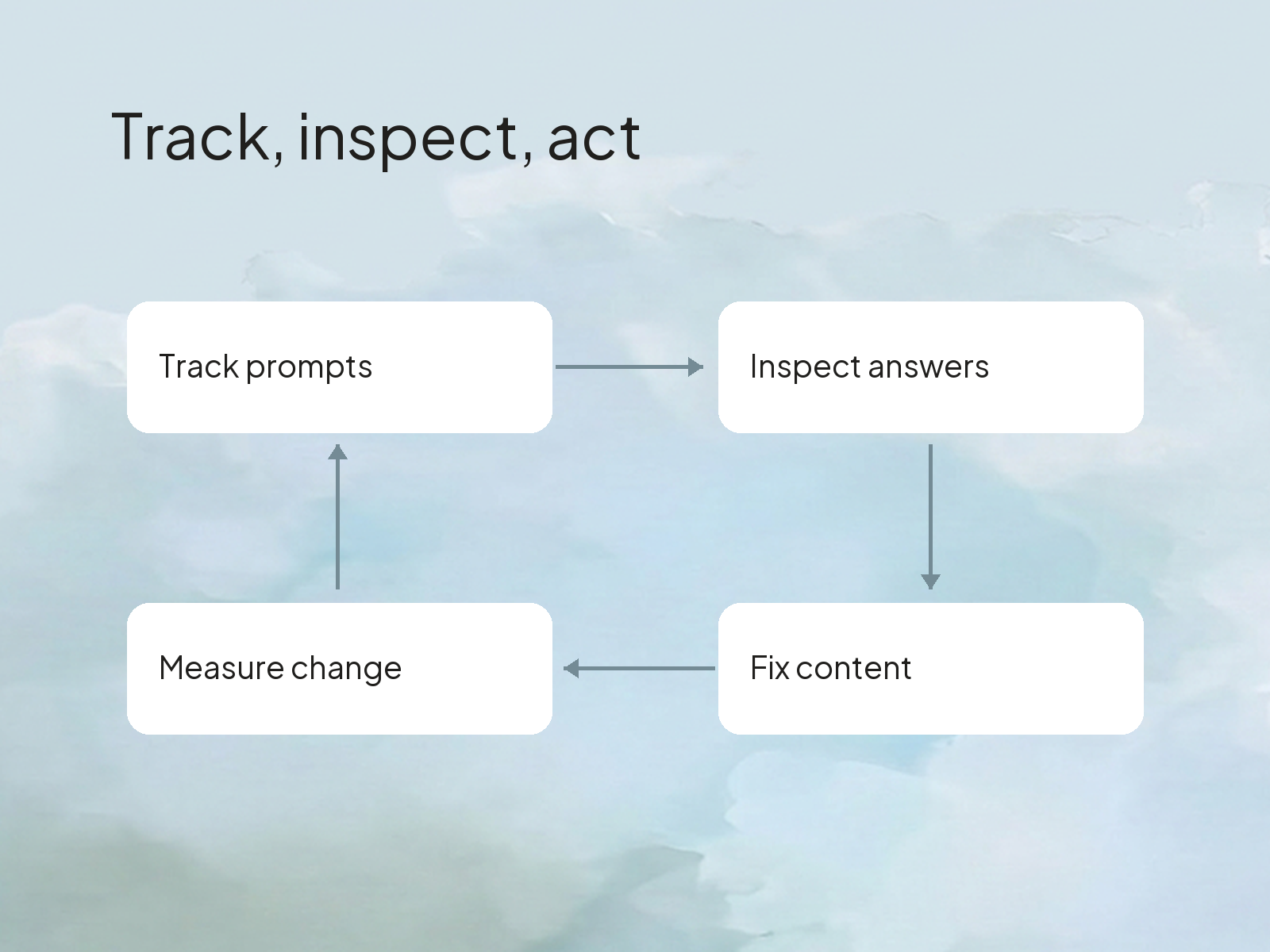
An AI visibility tool changes the workflow from ad hoc checking to a closed loop: track prompts, identify answer gaps, publish or update content, monitor changes, and repeat. The most useful output is not a vanity score. It is a prioritized list of content and source improvements.
For Anagram, this is the core distinction. Visibility tracking tells you where your brand is missing from AI answers. On-site AI experiences and shopper-question data help reveal what customers are asking before they buy. Together, those signals can inform product pages, FAQs, comparison content, and buying guides.
That closed loop matters because ChatGPT visibility does not improve from observation alone.
Can manual checks prove that GEO content worked?
Manual checks can suggest that a GEO change may have helped, but they cannot prove it by themselves. To evaluate whether content worked, you need repeated measurements, a stable prompt set, dates, source tracking, and enough samples to separate real movement from answer variability.
The same caution applies to traffic results. A 2026 field study on ChatGPT referral traffic found that raw referral growth can be inflated by platform-wide growth, and that treated pages should be compared against an untreated control when possible.
In other words, “ChatGPT traffic went up” is not automatically proof that one article caused the increase.
For practical teams, this means:
Track before and after publishing.
Keep prompt sets stable.
Compare similar pages when possible.
Record source URLs, not only mentions.
Treat small changes as directional until repeated.
When should you use both manual checks and a tool?
Use both when AI visibility matters enough to act on. Let the tool collect repeatable data, and use manual checks to inspect the actual answer quality. The tool shows the pattern. Manual review explains whether the answer is persuasive, accurate, and commercially useful.
A strong weekly workflow looks like this:
Review prompt-level visibility trends.
Open the most important changed answers manually.
Check whether your brand is framed correctly.
Identify missing or weak source pages.
Publish or update one answer-first content asset.
Recheck the same prompts after indexing and crawling.
Manual review remains important because AI visibility is not only about being mentioned. It is about being recommended for the right reason.
Frequently asked questions
Do I need a tool to track my ChatGPT visibility?
You do not need a tool for a one-time spot check. You do need a tool when you want consistent measurement across prompts, competitors, citations, and time. A spreadsheet can work at first, but it becomes unreliable once the prompt list or reporting need grows.
Is manual ChatGPT checking accurate?
Manual checking is accurate as a snapshot of one answer, but weak as a measurement method. ChatGPT answers can vary by timing, phrasing, search behavior, and source retrieval. Manual checks should be treated as qualitative evidence unless they are repeated and documented.
What should I track besides whether ChatGPT mentions my brand?
Track competitors, cited URLs, answer position, framing, prompt category, source quality, and the content action needed. A brand mention is only useful if the answer positions the brand accurately and gives the user a reason to consider it.
Is an AI visibility tool worth it for a small brand?
An AI visibility tool is worth it for a small brand when AI answers influence discovery, comparison, or purchase decisions and someone on the team will act on the findings. If no one will publish, update, or fix content, manual checks are enough for now.
Sources
OpenAI, “Introducing ChatGPT search” — https://openai.com/index/introducing-chatgpt-search/
OpenAI Help Center, “ChatGPT Search” — https://help.openai.com/en/articles/9237897-chatgpt-search
Gartner, “Search engine volume will drop 25% by 2026” — https://www.gartner.com/en/newsroom/press-releases/2024-02-19-gartner-predicts-search-engine-volume-will-drop-25-percent-by-2026-due-to-ai-chatbots-and-other-virtual-agents
Sielinski, “Quantifying Uncertainty in AI Visibility,” arXiv, 2026 — https://arxiv.org/abs/2603.08924
Watanabe and Nakayashiki, “Disentangling Answer Engine Optimization from Platform Growth,” arXiv, 2026 — https://arxiv.org/abs/2606.04362